
How To
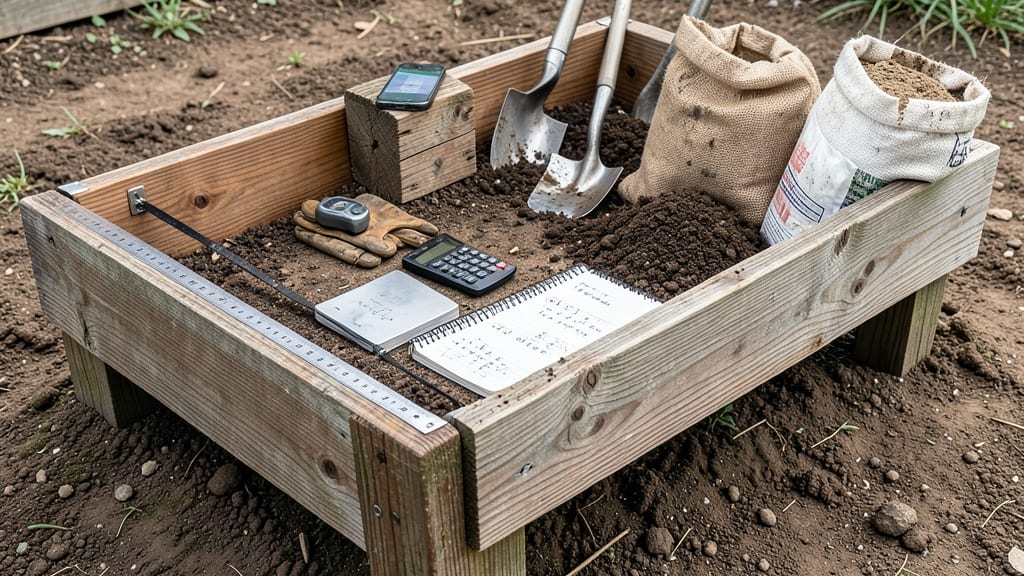
Calculating soil for your raised bed isn't guesswork—it's the secret to perfect plant support from day one. 🌱 I learned the hard way when my first raised bed turned into a muddy mess because I underestimated the soil volume.
The right amount means strong roots, fewer weeds, and plants that thrive instead of struggle.
You'll need a measuring tape, calculator, and a pencil to jot down your bed's dimensions. Multiply length by width by depth (typically 6-12 inches) to get cubic feet, then convert to pounds based on your soil mix—compost blends weigh more than native soil.
Most bags list coverage per inch of depth, but actual volume matters more for heavy plants like tomatoes or squash.
With the right math, you'll avoid the shock of running out mid-project or wasting money on extra soil. Picture your bed filled to the brim, roots spreading freely, and plants reaching for the sky—this is how you get there.
The payoff? A garden that looks and performs exactly as you imagined, with no surprises.
Pro tip: Round up for heavy plants or rocky soil, and keep a 5-10% buffer for settling. Whether you're filling a 4x8-foot bed or a small container, this method works every time. Let's get those measurements down and turn your plan into reality!
📚 In This Guide
- What you need
- Instructions
- Tips and common mistakes
- Wrapping up and next steps
What you need
- ● Raised bed frame – Pre-built or DIY (measure dimensions for volume calculations).
- ● Soil mix components (quantities depend on bed size; see calculations): Topsoil (1/3 to 1/2 of mix) – Look for "gardening soil" or "topsoil with compost".
- ● Compost (1/3 of mix) – Aged, organic compost (avoid fresh manure).
- ● Perlite or vermiculite (10%) – For drainage and aeration.
- ○ Peat moss or coconut coir (optional, 10%) – Improves moisture retention.
- ● Measuring tools: Tape measure (for bed dimensions).
- ● Wheelbarrow or large bucket (for mixing soil).
- ● Garden shovel or soil scoop.
- ○ Calculating scale (optional, for precise pound measurements).
- ● Soil amendments: Worm castings (5–10%) – Boosts nutrient density.
- ● Sand (if soil is too clay-heavy).
- ● Slow-release fertilizer (e.g., composted manure or granular fertilizer).
- ● Landscape fabric – Place under beds to block weeds and improve drainage.
- ● Garden gloves & knee pads – For comfort during heavy lifting.
- ● pH testing kit – Ensure your soil is in the ideal range (6.0–7.0) for most plants.
Step-by-step guide to calculating soil for your raised bed
Here's how I break down the numbers so you never overbuy or run short—every time.
📏 Step 1: Measure Your Raised Bed Dimensions
Start by measuring the length, width, and height of your raised bed in feet. I use a tape measure for accuracy, marking each dimension at the top edge. For example, a 4-foot by 8-foot bed that's 12 inches tall will give you the basic shape. Multiply length × width × height (in feet) to get the total cubic footage—this is your volume.
Real talk: If your bed has uneven sides or slopes, measure the average height by adding the heights of all four corners and dividing by four. This prevents underestimating soil needs. For a 4×8 bed with corners at 10", 12", 14", and 12", the average height is 12 inches (1 foot).
📊 Step 2: Convert Cubic Feet to Cubic Yards
Soil is sold by the cubic yard, so convert your cubic footage to cubic yards by dividing by 27 (since 1 cubic yard = 27 cubic feet). For a 4×8×1-foot bed: (4 × 8 × 1) ÷ 27 = 1.22 cubic yards. Round up to 1.5 cubic yards to account for settling and future additions.
I always add an extra 10-20% to my calculation. Soil settles over time, and you might want to add compost later. For a 2×6×1-foot bed (0.44 cubic yards), I’d round up to 0.5 cubic yards—just enough to avoid a last-minute trip to the nursery.
💧 Step 3: Calculate Soil Weight for Perfect Support
Different soil types weigh differently. A cubic yard of topsoil typically weighs 1,800-2,200 pounds, while compost or potting mix can range from 800-1,200 pounds. Multiply your cubic yards by the weight per cubic yard to estimate the total pounds you’ll need to move.
For a 1.5 cubic yard bed filled with topsoil: 1.5 × 2,000 = 3,000 pounds. That’s roughly the weight of a small car—so plan for help or a wheelbarrow! If you’re mixing soils (like 60% topsoil and 40% compost), calculate each component separately and add the weights.
🪴 Step 4: Adjust for Soil Type and Amendments
Not all soil is created equal. If your raised bed requires a mix (like 50% topsoil, 30% compost, and 20% perlite), calculate each component’s volume first. For a 1.5 cubic yard bed: 0.75 cubic yards topsoil, 0.45 cubic yards compost, and 0.3 cubic yards perlite. Convert each to pounds using their respective weights.
Here’s the thing—amendments like perlite or vermiculite add volume but not weight. A cubic yard of perlite might weigh only 200-300 pounds, so don’t assume it fills space like soil. I like to lay out bags of amendments before filling the bed to visualize coverage and avoid gaps.
✅ Step 5: Verify and Order Your Soil
Double-check your calculations by sketching a simple diagram of your bed. Label dimensions, cubic yards, and pounds for each soil type. This visual helps spot mistakes—like forgetting to account for a 6-inch layer of cardboard at the bottom (which reduces usable soil volume).
Order 10% more soil than calculated to cover settling and spills. I’ve learned the hard way that a "quick fix" trip to the store mid-project is no fun. Call your supplier ahead of time to confirm delivery options—some soils need to be spread immediately, while others can cure for a few days.
Tips & tricks for perfect raised bed soil calculations
Common pitfalls—and how to sidestep every one when calculating soil for your raised bed.
Precision in Measurements: When measuring your bed's dimensions, use a rigid tape measure instead of a flexible one—flexible measures can stretch and give you inaccurate readings. For beds with sloped sides, measure the shortest and longest points, then average them to get a more accurate height. I once ordered 1.8 cubic yards for a 4×8 bed by eyeballing, only to realize I was short after filling it—don't make my mistake!
Conversion Double-Check: The 27-cubic-foot-to-cubic-yard conversion is critical. I recommend writing it down as "27 cubic feet = 1 cubic yard" and using a calculator to avoid mental math errors. For example, a 3×6×1-foot bed equals 18 cubic feet, which converts to just 0.67 cubic yards—rounding up to 0.75 cubic yards prevents shortages. Double-check your math before ordering!
Soil Weight Reality: Remember that topsoil weighs significantly more than compost or potting mix. A cubic yard of topsoil at 2,000 pounds means your 1.5 cubic yard bed could weigh 3,000 pounds—that's heavier than most people realize! If you're mixing soils, calculate each component separately. I once tried to move 2.5 cubic yards of topsoil alone and needed three people to lift the bags—plan accordingly.
Visualizing Your Mix: Before ordering, sketch a simple diagram of your bed with labeled sections for each soil type. This helps visualize how much space each component will occupy. For a 50/30/20 mix of topsoil/compost/perlite in a 1.5 cubic yard bed, that's 0.75 cubic yards topsoil, 0.45 cubic yards compost, and 0.3 cubic yards perlite. Laying out bags beforehand prevents surprises when filling the bed.
Pro Tips for Calculate Soil For Raised Bed
- Common pitfalls—and how to sidestep every one when calculating soil for your raised bed.
- Precision in Measurements: When measuring your bed's dimensions, use a rigid tape measure instead of a flexible one—f...
- Conversion Double-Check: The 27-cubic-foot-to-cubic-yard conversion is critical. I recommend writing it down as "27 c...
Frequently asked questions
Got questions about calculating soil for your raised bed? You’re not alone—here are some of the most common concerns (and answers!) to help you get it right the first time.
How do I calculate soil volume for a raised bed?
Multiply the bed’s length × width × depth (in feet) to get cubic feet, then convert to cubic yards (divide by 27). For example, a 4’x8’ bed filled 12” deep needs 3.5 cubic yards of soil. Pro tip: Round up slightly to account for settling!
What’s the best depth for a raised bed?
Aim for 6–12 inches deep for most vegetables and herbs—deep enough for roots but shallow enough to manage. For larger plants like tomatoes or potatoes, extend to 18–24 inches to support deeper growth. Deeper beds also reduce watering frequency!
Can I mix my own soil instead of buying pre-mixed?
A balanced DIY mix includes 60% topsoil, 30% compost, and 10% perlite or sand for drainage. Test your soil’s pH (ideal: 6.0–7.0 for most plants) and amend as needed. Save money, but ensure the topsoil is high-quality to avoid poor drainage.
When is the best time to fill a raised bed with soil?
Fill the bed 4–6 weeks before planting to let the soil settle and microbes establish. In cold climates, add mulch in fall to protect soil over winter. Avoid filling in freezing temps—soil compacts and drains poorly until thawed.
How do I adjust for heavy or clay soil in my mix?
Amend heavy clay or compacted soil with 20–30% coarse sand or perlite to improve drainage. For sandy soil, add 20% peat moss or coconut coir to retain moisture. Aim for a crumbly, well-aerated texture—like a damp sponge!
What if my raised bed soil sags after planting?
Sagging is normal due to settling. Top off with 1–2 inches of fresh compost or potting mix after planting. For long-term stability, use landscape fabric or hardware cloth as a barrier between old soil and new fill. Check depth again in 2–3 weeks and adjust!
Wrapping up and next steps
Calculating the right amount of soil for your raised bed is the foundation of a thriving garden—no guesswork needed!
By measuring volume, converting to pounds, and accounting for amendments, you’ll create the perfect growing environment for your plants. Now that you’ve mastered the math, it’s time to roll up your sleeves and build that dream garden!
Your next step? Grab your soil, tools, and a shovel—then start filling that bed with confidence! 🌱✨