
How To
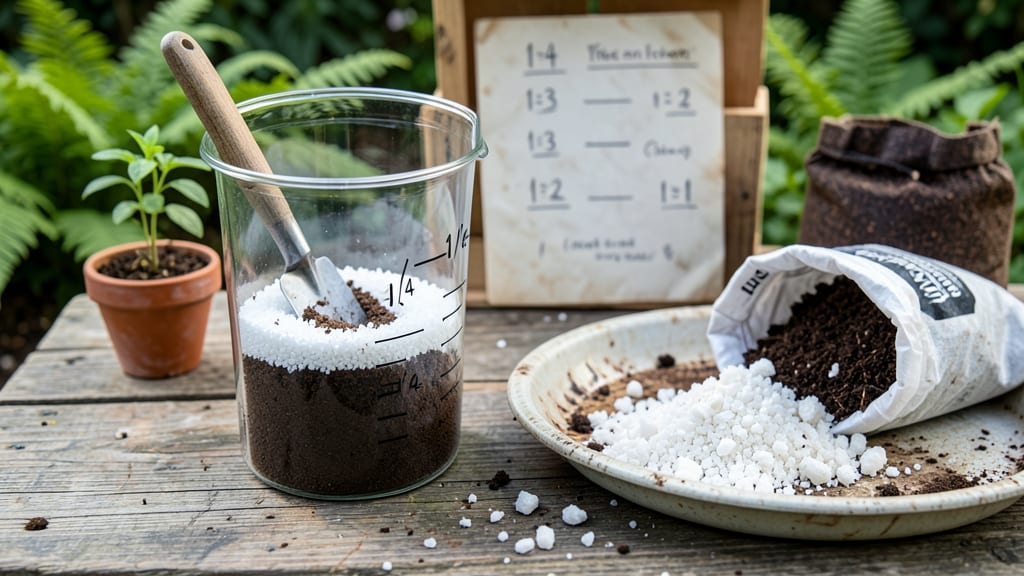
Determining the right soil perlite ratio depends entirely on your plant type: seedlings and cuttings need 1 part perlite to 3 parts soil for gentle root development, while succulents and cacti require 1 part perlite to 2 parts soil to prevent rot. For dense garden beds, 20-30% perlite breaks up heavy soil, and moisture-sensitive plants like ferns thrive with 10-15% perlite to balance airflow and hydration.
Perlite isn't just about drainage—it transforms soil structure by creating tiny air pockets that roots crave. 🌱 This lightweight volcanic glass expands when heated, adding porosity without altering soil chemistry. Unlike sand or vermiculite, perlite stays inert, so it won't break down or alter pH over time.
The magic happens in how it mimics natural aeration, which is why gardeners swear by it for everything from seed-starting mixes to hydroponic systems.
For practical application, think of perlite as your soil's personal climate control. In arid regions, you might bump up the ratio slightly (e.g., 1:1.5) to help moisture cling to roots longer, while humid climates can lean toward the lower end (1:3) to prevent soggy conditions.
Houseplants like pothos often do well with 10% perlite—just enough to keep roots breathing without sacrificing moisture retention.
💡 In This Article
- How Perlite Improves Soil Structure and Plant Health
- Custom Perlite Mixes for Specific Plants and Growth Stages
How perlite improves soil structure and plant health
Perlite works its magic through a process called soil aeration, where its porous, expanded structure creates microscopic air channels that roots can access.
When mixed into soil, each perlite particle contains thousands of tiny air pockets—imagine a sponge with a surface area of 100-200 square feet per cubic foot of perlite. This isn't just about drainage; it's about giving roots the oxygen they need to respire efficiently.
Without proper aeration, roots suffocate, leading to stunted growth or even rot. The ideal scenario is a soil mix where 25-30% of the volume is air space, which perlite helps achieve effortlessly.
What sets perlite apart from other amendments like sand or vermiculite is its neutral pH (7.0) and chemical inertness. Unlike organic matter that decomposes over time, perlite remains stable for years, maintaining its structure without altering soil chemistry.
For example, sand improves drainage but doesn't add air pockets—it just creates larger voids that water drains through too quickly. Vermiculite, while excellent for moisture retention, can compact when wet, reducing its effectiveness.
Perlite strikes the perfect balance: it stays light and fluffy, preventing compaction while allowing excess water to drain away from roots within 1-2 hours after watering.
Consider the case of African violets, which thrive in a 1:3 perlite-to-soil ratio. The perlite creates a loose, almost velvety texture that mimics their native humus-rich forest floors.
When you squeeze a handful of this mix, it should feel firm but springy, like a well-used sponge—not dense like clay or crumbly like dry sand. This texture prevents the delicate roots from becoming waterlogged, which is crucial because African violets are sensitive to root rot.
The same principle applies to orchids, where a 20% perlite content ensures their epiphytic roots get both airflow and moisture without suffocation.
The science behind perlite's effectiveness lies in its hydrophobic surface. While it absorbs water initially, it releases it slowly, acting like a built-in irrigation system. This is why gardeners often see 30-50% faster root growth in perlite-amended soils compared to unamended mixes.
For instance, tomato seedlings grown in a 1:4 perlite-to-soil mix develop roots that are 20% longer within four weeks because the perlite prevents anaerobic conditions (lack of oxygen) that stifle root development.
The key is achieving this balance without overdoing it—too much perlite (over 50% by volume) can make the mix too dry, while too little (5%) fails to provide meaningful aeration.
One common misconception is that perlite only benefits sandy soils. In reality, its advantages are most critical for clay-heavy soils, where compaction is a major issue.
A 25% perlite addition to clay can improve drainage by 400-600%**, reducing the time water sits in the root zone from days to mere hours.
For container gardens, where soil has no natural structure to rely on, perlite becomes even more essential—it prevents the crusting effect that occurs when water evaporates from the surface, leaving a hard, impermeable layer that roots can't penetrate.
To visualize this, think of perlite as the soil's internal scaffolding. Just as a building's framework supports its structure, perlite supports root systems by preventing collapse under moisture or pressure.
This is particularly important for hydroponic systems, where perlite is often used as a 20-30% component in rockwool or clay pebble mixes to ensure roots stay oxygenated even in water-based environments. The result?
Plants that grow 2-3 times faster than in standard soil because their roots aren't struggling for air or water.