
How To
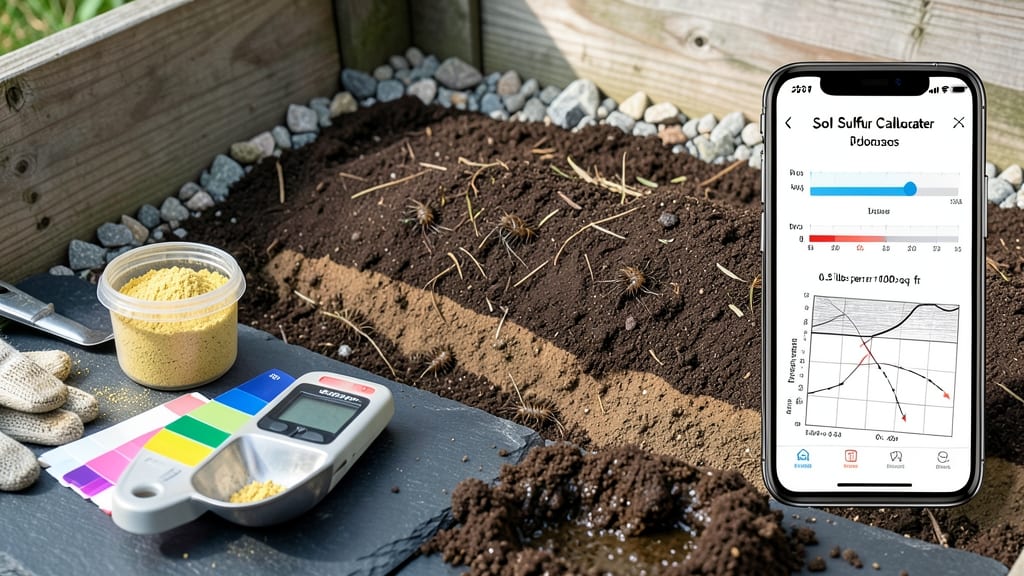
A soil sulfur calculator helps you calculate the precise sulfur amendments your garden needs by evaluating soil test data, crop-specific requirements, and organic matter percentages to avoid deficiencies or toxic buildup. Simply input your soil's pH, organic content, and target plants for accurate recommendations.
A soil sulfur calculator bridges the gap between raw soil test numbers and real-world gardening decisions. 🌱 The tool accounts for how different plants—like sulfur-hungry brassicas (broccoli, cabbage) versus legumes—absorb nutrients differently, while also factoring in how organic matter breaks down over time.
For example, a soil with 3% organic matter will release sulfur at a different rate than one with 10%, requiring adjustments to your amendment plan. Many calculators also integrate with university-backed soil databases to refine their predictions, though they still rely on your input for accuracy.
Most calculators walk you through three key steps: entering your soil's cation exchange capacity (CEC), selecting your target crops, and adjusting for local climate conditions. 💡 The results often include both elemental sulfur and sulfate-based amendments, with clear dosing instructions.
For instance, if your soil test shows a pH of 6.5 and you're growing tomatoes (which prefer slightly acidic soil), the calculator might recommend 0.5 pounds of sulfur per 100 square feet—but only if your organic matter is below 5%.
💡 In This Article
- How Soil Sulfur Calculators Work with pH and Plant Needs
- Step-by-Step Guide to Using a Soil Sulfur Calculator
How soil sulfur calculators work with pH and plant needs
The science behind sulfur calculations starts with understanding how sulfur cycles in soil. Most calculators focus on two key processes: sulfate conversion and organic matter mineralization.
When you add elemental sulfur (the most common amendment), soil microbes oxidize it into sulfate (SO₄²⁻) over 4-8 weeks, depending on moisture and temperature. This sulfate then becomes available for plant uptake or can be lost through leaching if your soil is sandy or has high rainfall.
The calculator accounts for this lag time by recommending doses that account for both immediate and delayed release.
Plant needs vary dramatically by species. For example, brassicas (broccoli, cabbage) require 20-30 ppm sulfur in their tissue, while legumes (beans, peas) need only 10-15 ppm. The calculator uses these uptake rates to determine how much sulfur your soil must release per growing season.
It also factors in how different crops affect soil pH—brassicas, for instance, can acidify soil over time, increasing sulfur solubility. Meanwhile, legumes may raise pH slightly, reducing sulfur availability.
This is why the same soil might need 0.3 lbs/100 sq ft for tomatoes but 0.7 lbs/100 sq ft for Brussels sprouts.
Organic matter plays a hidden but critical role. Decomposing plant residues release sulfur gradually, but the rate depends on their carbon-to-nitrogen ratio. A soil with 8% organic matter might contribute 50% of its sulfur needs naturally, while one with 2% organic matter could require nearly 100% external amendment.
The calculator adjusts for this by estimating mineralization rates based on your soil's organic carbon content—typically 1-3% of organic matter converts to plant-available sulfur annually. This is why a "low-sulfur" soil might still test adequate if it's rich in compost.
pH adjustments complicate things further. Sulfur's availability peaks at pH 6.0-6.5—below this, aluminum toxicity can mask sulfur deficiency symptoms (yellowing leaves), while above 7.0, sulfate becomes less soluble.
Calculators often recommend elemental sulfur for alkaline soils (to lower pH) and sulfate-based fertilizers for acidic soils (to provide immediate sulfur).
For example, if your soil pH is 7.8 and you're growing peppers (which prefer 6.0-6.8), the calculator might suggest 0.8 lbs/100 sq ft of elemental sulfur while also warning that this will take 3-4 months to fully acidify the soil.
One often-overlooked factor is sulfur volatilization. In hot, dry climates, up to 30% of applied elemental sulfur can oxidize into gaseous forms (like hydrogen sulfide) and escape. Calculators for arid regions often include a 1.5x safety factor to compensate.
Conversely, in waterlogged soils, sulfur can be lost through denitrification, requiring even higher doses. The best calculators let you input your local climate zone to account for these regional variations.
For a real-world example, consider two gardens with identical soil tests but different crops. Garden A grows cauliflower (high sulfur demand) in 5% organic matter soil at pH 6.2, while Garden B grows squash (low sulfur demand) in 10% organic matter soil at pH 6.8.
The calculator might recommend 0.6 lbs/100 sq ft for Garden A (accounting for high plant uptake and moderate organic matter) but only 0.1 lbs/100 sq ft for Garden B (where organic matter already supplies most needs). This precision is why inputting accurate plant and soil data is non-negotiable.
Understanding these mechanisms helps explain why generic "add sulfur if your soil tests low" advice fails. The calculator's magic lies in its ability to weigh these variables simultaneously—balancing what your plants need, what your soil can supply, and how environmental factors will influence the process. 🌱