
How To
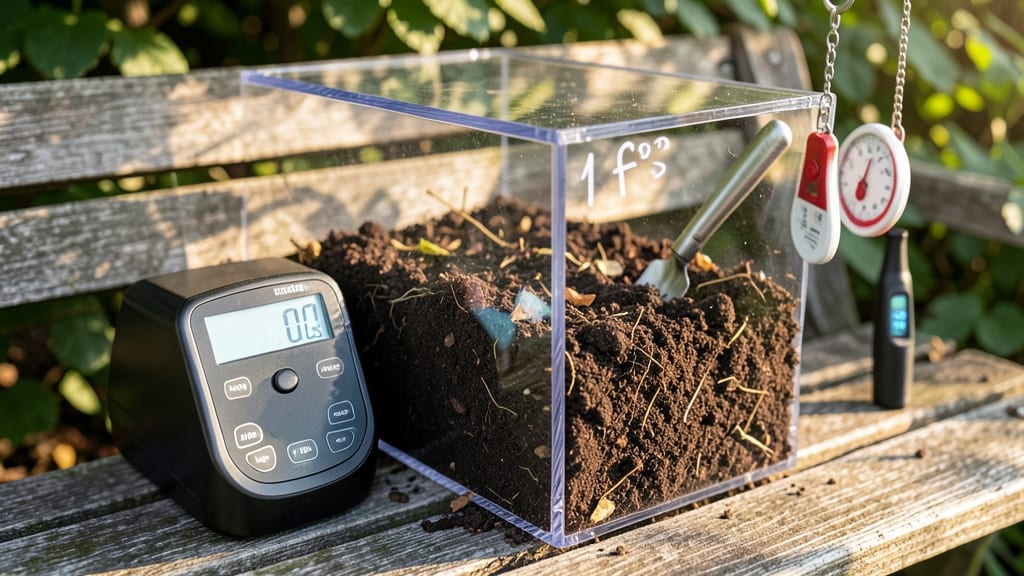
Understanding soil weight per cubic foot reveals sandy soil typically weighs 70-80 pounds, loamy soil ranges from 80-100 pounds, and clay soil reaches 100-135 pounds—moisture can increase these weights by 10-20% due to water absorption and density shifts.
Soil weight isn't just about dirt—it's a science of particle size and moisture content. 🌱 Sandy soils weigh less because their large particles create more air pockets, while clay's tiny particles pack tightly, increasing density.
Even a small change in moisture can shift the weight significantly, which is why gardeners often account for seasonal variations when calculating soil loads for raised beds or foundation projects.
This matters most when you're working with heavy containers or planning outdoor structures. For example, a 4'x4' raised bed filled with loamy soil could weigh over 1,000 pounds when saturated—far more than most wooden frames are designed to support.
I always recommend testing soil moisture before major projects to avoid unexpected weight surprises.
💡 In This Article
- How Soil Composition Affects Weight Per Cubic Foot
- Practical Applications for Estimating Soil Weight in Gardening
How soil composition affects weight per cubic foot
The weight of soil per cubic foot is fundamentally determined by its particle size distribution and how tightly those particles pack together.
Sandy soil, with its large 0.05-2mm particles, creates a loose, porous structure that allows air to occupy up to 45% of the volume—this is why it weighs only 70-80 pounds per cubic foot.
The larger particles can't pack as densely, leaving more space for air rather than solid matter. 🌊 In contrast, clay soil contains particles smaller than 0.002mm, which can pack together like tightly stacked marbles, reducing air space to just 30-40% and increasing weight to 100-135 pounds per cubic foot.
Organic matter plays a surprising role too—even though compost and decomposed plant material are lightweight, they actually increase bulk density when mixed into soil.
A cubic foot of pure organic matter might weigh only 30-50 pounds, but when incorporated into mineral soil, it fills the air pockets between particles, effectively "gluing" them together.
Loamy soil, the ideal gardening medium, strikes a balance with roughly 40% sand, 40% silt, and 20% clay, plus 5-10% organic matter, giving it that 80-100 pound per cubic foot sweet spot where weight and fertility align perfectly.
Moisture becomes the wild card in these calculations. Water weighs 62.4 pounds per cubic foot itself, and soil can absorb 20-30% of its dry weight in water through capillary action—tiny water pathways between particles.
A cubic foot of sandy soil might hold just 0.1 gallons of water, adding 0.8 pounds, while clay can retain 0.5 gallons, adding a hefty 4 pounds.
This is why saturated clay soil can suddenly become 20% heavier after rain, while sandy soil shows minimal weight gain. The real game-changer is how water reduces porosity—when pores fill with water instead of air, the soil structure effectively "shrinks" in terms of its load-bearing capacity.
Let's look at the numbers more precisely: The specific gravity of quartz (the main mineral in sand) is 2.65, meaning each cubic foot of pure quartz would weigh 165 pounds if perfectly compacted. But in nature, sand rarely achieves this density due to its loose packing.
Clay minerals like kaolinite have even higher specific gravities (2.6-2.7), but their tiny plate-like shapes allow them to interlock when wet, creating that dense, heavy structure.
What's fascinating is how these microscopic interactions scale up—what seems like a simple weight measurement is actually a complex interplay of mineralogy, physics, and hydrology working at the particle level.
One often-overlooked factor is soil compaction. When soil is tilled or walked on, the particles get pushed closer together, reducing air space and increasing weight. A 10% compaction increase can add 5-10 pounds per cubic foot to sandy soil but only 2-3 pounds to clay.
This explains why construction sites often specify "undisturbed soil" measurements—any human activity can significantly alter the weight calculations you might find in reference tables. For gardeners, this means your freshly tilled raised bed might weigh 15% more than the same volume of undisturbed soil from your yard.
Here's a practical way to visualize these differences: Imagine carrying two buckets—one filled with 75 pounds of dry sand and another with 120 pounds of wet clay. The sand feels light and pours easily, while the clay feels dense and heavy, almost like wet cement.
That weight difference directly translates to how much your plant containers or garden structures need to support. The key takeaway is that soil weight isn't static—it's a dynamic property that changes with moisture, compaction, and even seasonal freeze-thaw cycles that alter particle arrangement. 💫