
How To
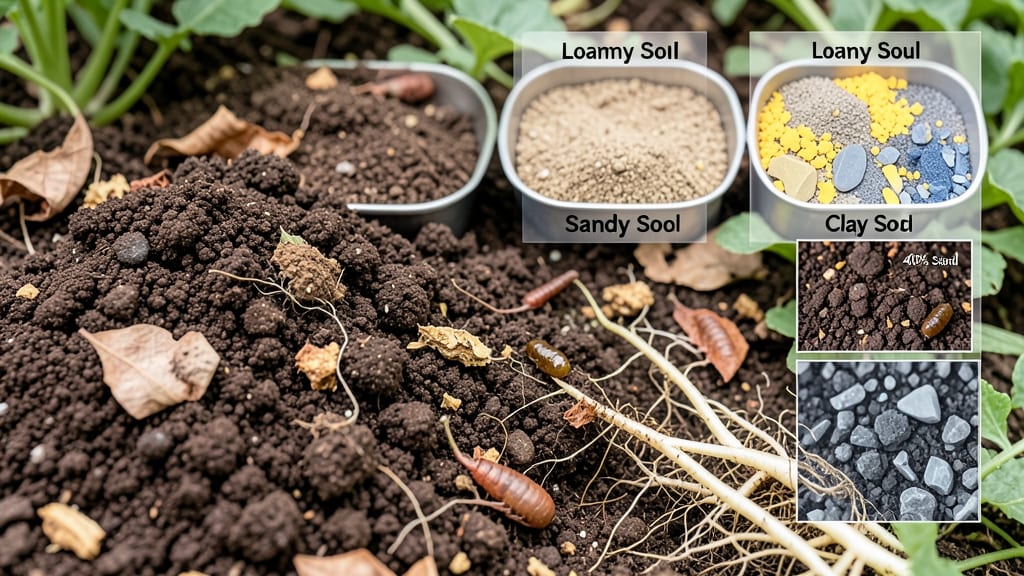
Loamy soil is made of roughly 40% sand, 40% silt, and 20% clay, creating a balanced texture that retains moisture while allowing airflow and root penetration for optimal plant growth.
This ideal soil composition works because the mix balances three key properties: sand provides drainage, silt holds nutrients, and clay retains moisture. 🌱 The result is a crumbly texture that roots love—neither too dense nor too loose.
Unlike pure sand (which drains too fast) or heavy clay (which suffocates roots), loamy soil acts like a sponge for plants, making it the gold standard for gardens. Most healthy garden soils naturally fall into this range, though urban or heavily tilled areas may need adjustments.
What makes loamy soil truly special is how its particle sizes interact. Sand particles are coarse, silt is medium, and clay is fine—together they create tiny air pockets that help roots breathe while still holding water and nutrients where plants need them.
This structure is why gardeners obsess over achieving loam: it’s the reason your tomatoes thrive in a backyard plot but struggle in pure sand or waterlogged clay.
💡 In This Article
- The Science Behind Loamy Soil Composition
- How to Test and Improve Your Garden’s Loamy Soil
The science behind loamy soil composition
The magic of loamy soil lies in its particle size distribution, where each component plays a distinct role. Sand particles (0.05-2mm) create large pores that allow water and air to move freely, preventing suffocation.
Silt (0.002-0.05mm) acts like a sponge, holding water and nutrients just out of reach of plant roots until needed. Clay (<0.002mm) forms tiny plates that stick together, creating a reservoir for moisture and nutrients while also providing negative charges that attract essential minerals.
This 40-40-20 ratio isn't arbitrary—it's the sweet spot where physics and chemistry align. The sand prevents compaction, while the silt and clay work together to create a stable crumb structure.
When you squeeze a handful of ideal loam, it should hold its shape but break apart easily—like damp cookie dough. 🌱 The clay particles also form micropores that hold water via capillary action, while the sand's macropores ensure excess water drains away, preventing root rot.
This dual system explains why loamy soil can hold 25-30% water by volume while still providing 10-30% air space for roots.
What most gardeners overlook is the organic matter component that typically makes up 5-10% of loamy soil. This includes decomposed plant material, fungi, and microbial biomass that glues the mineral particles together. Without it, even a perfect 40-40-20 mix would break down into separate layers.
The organic matter also acts as a nutrient buffer, slowly releasing phosphorus and nitrogen as plants demand them. Think of it as the soil's circulatory system—keeping everything connected and functional.
Temperature plays a surprising role too. In cooler climates, loamy soil's structure helps maintain 50-60°F temperatures at the root zone, protecting sensitive plants. Meanwhile, in hot regions, the sand component prevents overheating by reflecting sunlight.
The clay's heat capacity also helps regulate temperature swings. This thermal stability is why loamy soil supports year-round gardening in diverse climates—from Mediterranean vineyards to temperate vegetable plots.
Here's a visual comparison to understand the differences better:
- Pure sand: Drains too fast (0-5% water retention), feels gritty, and lacks nutrients
- Pure clay: Holds too much water (40-60% retention), becomes waterlogged, and suffocates roots
- Loamy soil: Perfect balance (25-30% retention), crumbly texture, and ideal aeration
This balance explains why 90% of agricultural soils worldwide are classified as loam or loam-like. The ratio may vary slightly (sometimes 30-40-30), but the principle remains: diversity in particle sizes creates functional space for both water and air. 🌍