
How To
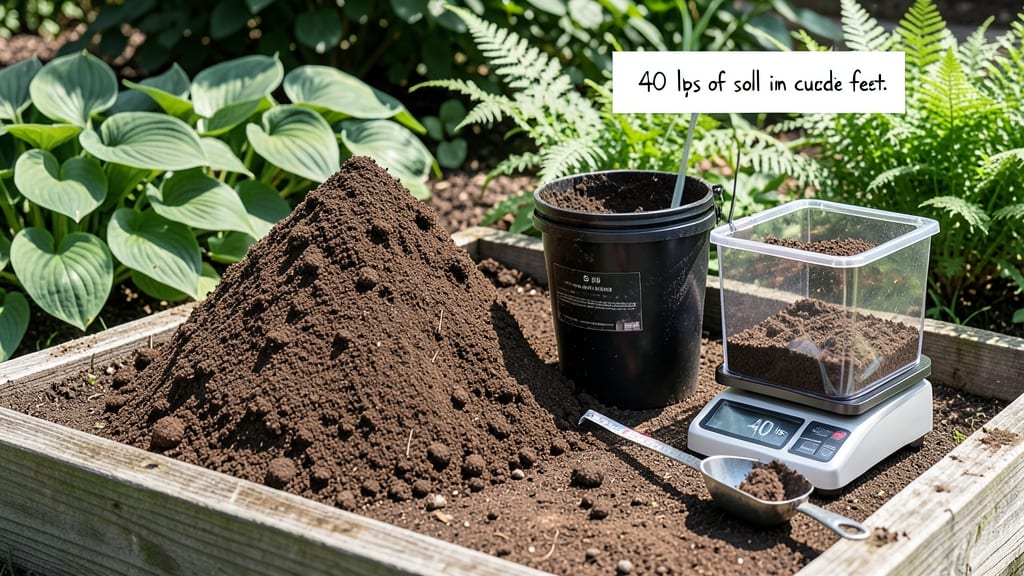
Converting 40 lbs of soil to cubic feet gives you roughly 1.4 to 1.8 cubic feet, with variations based on soil composition. Sandy soils occupy more space due to larger air pockets, while clay or loam soils pack more densely. Moisture levels also play a critical role—wet soil can weigh significantly more per cubic foot.
Understanding this conversion helps whether you're filling raised garden beds or calculating material needs for landscaping. 🌱 Soil density isn't just about weight—it's about the balance of minerals, organic matter, and air space.
For example, a 20-pound bag of potting mix might measure about 0.7 to 0.9 cubic feet, while 50-pound bags could reach 2.2 cubic feet depending on the mix.
When planning projects, always check the bag's labeled volume or use a simple formula: divide total pounds by 25 (a rough average density) to estimate cubic feet, then adjust based on your soil type.
Pro tip: If you're mixing soil with amendments like compost or perlite, these additions can change the overall density. For instance, adding 20% perlite to heavy clay soil will lighten the mix, increasing its volume per pound.
Always test your final blend by weighing a known volume—this gives you the most accurate conversion for your specific project.
💡 In This Article
- How Soil Type Affects Weight-to-Volume Conversion
- Practical Soil Volume Calculations for Gardening Projects
How soil type affects weight-to-volume conversion
The weight-to-volume relationship in soil hinges on its particle size distribution and porosity. Sandy soils have large particles (0.05–2mm) with high air spaces—think of it like packing marbles versus sand. This makes 40 lbs of sand occupy about 1.8 cubic feet due to those air pockets.
Clay soils, with particles smaller than 0.002mm, pack tightly with minimal air space, so the same weight might only fill 1.4 cubic feet. Loam—a balanced mix of sand, silt, and clay—falls in between, typically around 1.6 cubic feet for 40 lbs.
Moisture content adds another layer. Dry sand weighs about 100 lbs per cubic foot, but when wet, it can reach 120 lbs per cubic foot as water fills those air pockets.
Clay holds moisture differently—it expands when wet, reducing its overall volume per pound. 🌧️ Organic matter (like compost) further complicates things: a 20% compost mix can increase volume by 10-20% because organic particles break down and create more air space.
The USDA soil texture triangle helps visualize these variations, showing how even slight shifts in composition drastically alter density.
For gardeners, this means your 40-lb bag of "garden soil" might not match a neighbor's "topsoil" bag. A bag labeled "potting mix" often includes perlite or vermiculite to lighten the weight, increasing volume per pound.
Test your soil: Fill a 12-inch cube container, weigh it, then divide by 12 to find your specific density. This DIY method reveals whether your soil leans toward sandy (lighter) or clay-heavy (denser) characteristics.
Consider this real-world example: A 4'x8' raised bed filled 12 inches deep needs 32 cubic feet of soil. Using sandy soil (1.8 cu ft/lb), you'd need about 580 lbs of soil. But with clay (1.4 cu ft/lb), you'd require 740 lbs.
That's a 260-lb difference—enough to change your budget or delivery logistics. Always check soil labels for "bulk density" (lbs per cubic foot) if precision matters.
Advanced gardeners often blend soils to optimize density. Mixing 60% clay (heavy) with 30% sand (light) and 10% compost creates a balanced loam. This blend typically weighs 1.5–1.7 lbs per cubic foot, ideal for most plants.
The key is understanding how each component alters the overall structure—small changes in composition can mean big differences in volume and weight.
Pro tip: If you're working with containers or bags, fill them completely and weigh them to calculate your exact soil's density. For instance, a 5-gallon bucket holds about 0.67 cubic feet.
Weigh it full of your soil, then divide the weight by 0.67 to find your soil's pounds-per-cubic-foot ratio. This hands-on approach beats guesswork every time. 🔍