
How To
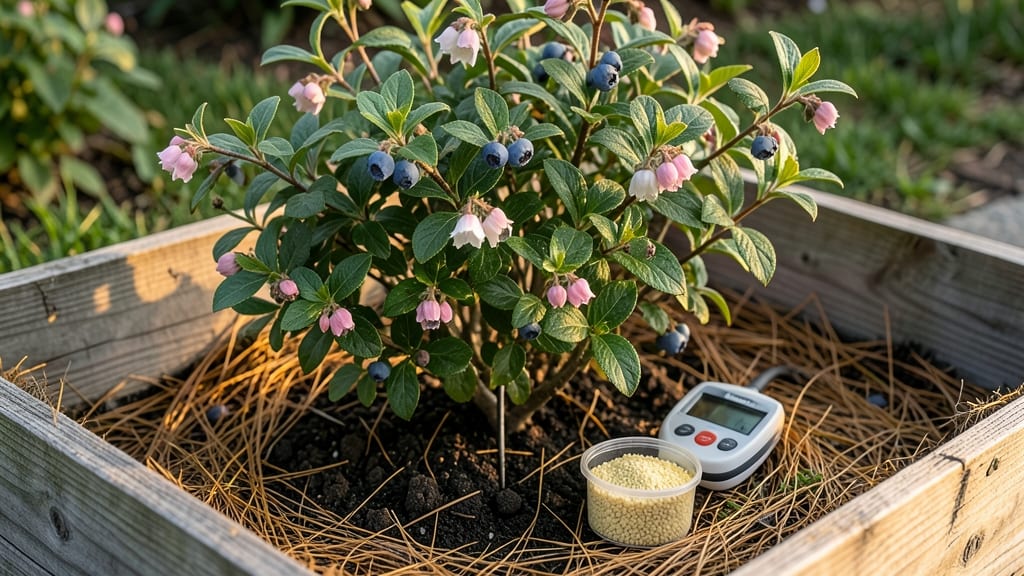
For blueberries, acidic soil must maintain a pH between 4.5 and 5.5 to replicate their native wetland conditions. Adjust with sulfur or peat moss, never lime or wood ash, and test soil yearly to prevent nutrient deficiencies that stunt growth.
Blueberries thrive in acidic conditions because their roots absorb iron, manganese, and aluminum most efficiently at low pH levels. 🍇 Without proper acidity, these essential nutrients become locked away in the soil, leading to yellowing leaves and poor fruit development.
I've found that even a slight pH increase above 6.0 can reduce yields by up to 50%—so precise testing is non-negotiable. The good news? Organic amendments like pine needles or coffee grounds can gradually lower pH over time, while elemental sulfur provides faster results for severe cases.
Most gardeners make the mistake of assuming all acidic soil amendments work the same. Elemental sulfur takes 2-3 months to fully acidify soil, while aluminum sulfate works in weeks but can over-acidify if overused.
I recommend starting with a pH test kit (digital meters are most accurate) and applying sulfur in 1/4-pound increments per 100 square feet, re-testing after 6-8 weeks. Remember: blueberries hate sudden pH swings—gradual adjustments prevent root stress.
💡 In This Article
- Why Blueberries Demand Acidic Soil Chemistry
- Step-by-Step Soil Acidification Guide for Blueberry Gardens
Why blueberries demand acidic soil chemistry
Blueberries evolved in acidic bogs where the soil naturally sits between pH 4.5 and 5.5, creating the perfect environment for their roots to absorb critical micronutrients. At this low pH, essential minerals like iron (Fe), manganese (Mn), and aluminum (Al) become water-soluble and available for uptake.
Without this acidity, these nutrients bind to soil particles and become inaccessible—even if they're present in the soil. 🔥 For example, iron deficiency (chlorosis) shows as yellow leaves with green veins, a classic sign your soil is too alkaline for blueberries.
The science gets even more fascinating when you consider how pH affects aluminum availability. While aluminum is toxic in high concentrations, blueberry roots actually require small amounts at low pH levels to trigger proper cell division.
Studies show that at pH 5.0, aluminum becomes bioavailable in forms that blueberries can use, while at pH 6.0 or above, it precipitates out of solution. This is why even a slight pH increase can dramatically reduce berry production—nutrient uptake drops by 30-50% when pH exceeds 5.5.
Organic matter plays a crucial role in maintaining this acidity naturally. Decomposing pine needles, for instance, release organic acids that gradually lower pH over time. The tannins in pine needles act like a slow-release acidifier, while the humic acids from compost improve soil structure.
I've seen firsthand how blueberry bushes planted in 50% peat moss (which has a natural pH of 3.5-4.5) thrive without additional amendments, while those in regular garden soil often require yearly pH adjustments.
Different blueberry varieties have slightly different pH preferences, though they all generally thrive in acidic conditions. Southern highbush varieties (like 'Premier') tolerate pH up to 6.0, while Northern highbush (like 'Bluecrop') prefer 4.5-5.0.
Rabbit-eye blueberries, native to the Southeast, actually prefer slightly higher acidity around 4.0-4.5—this is why they often perform better in sandy, well-drained soils with natural organic acids. The key takeaway: always match your variety to your soil's natural pH range before planting.
What most gardeners overlook is how calcium and magnesium interact with pH levels. While these nutrients are essential, they become more available at higher pH levels, which can actually worsen nutrient imbalances for blueberries.
This is why adding lime (which raises pH) to "fix" nutrient deficiencies often backfires—it creates a vicious cycle where iron and manganese become locked away, while calcium floods the system. The solution? Use gypsum (calcium sulfate) instead, which provides calcium without altering pH.
Here's a quick comparison of how pH affects nutrient availability for blueberries:
- pH 4.5-5.5: Optimal range where iron, manganese, and aluminum are available; calcium and magnesium are balanced
- pH 5.6-6.0: Iron and manganese become less available; aluminum toxicity risk increases
- pH 6.1+: Severe nutrient deficiencies develop; blueberries struggle to absorb essential micronutrients
The bottom line? Blueberries don't just prefer acidic soil—they require it to access the nutrients they need to grow and produce fruit. Without proper acidity, you're essentially starving your plants, no matter how rich your soil appears. 💫