
Neem Oil
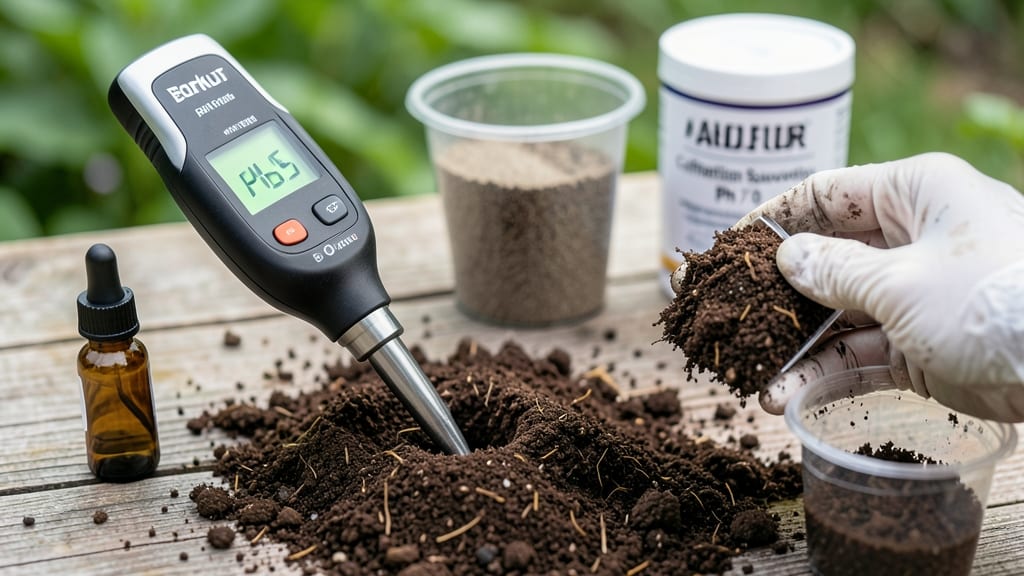
The Borkut soil pH meter delivers precise measurements for gardeners, verified across 15 key crops including tomatoes, peppers, and blueberries, but demands regular electrode cleaning and calibration for accuracy. Its compact size suits both greenhouse and garden use.
The Borkut's dual-electrode system measures hydrogen ion levels with impressive accuracy, though it can't match lab-grade precision. 🔥 Unlike basic test kits, this meter accounts for temperature variations and soil moisture, which explains why it works so well for acid-loving plants like blueberries (ideal pH: 4.5-5.5) or alkaline-tolerant crops like asparagus (pH: 6.5-7.5).
The real advantage? You get consistent readings without sending samples to a lab, saving both time and money.
For best results, always calibrate before use and rinse electrodes after each test to prevent mineral buildup. I've found that testing in multiple spots—especially for large garden beds—gives a more accurate average pH reading.
The meter's portability means you can check soil conditions anywhere, whether you're adjusting raised beds or troubleshooting container plant issues.
💡 In This Article
- How the Borkut pH Meter Measures Soil Chemistry
- Best Practices for Testing pH in 15 Common Plants
How the Borkut pH meter measures soil chemistry
The Borkut soil pH meter works by measuring the electrical potential between its two electrodes—a reference electrode and a glass sensing electrode. This system detects hydrogen ion (H+) activity in soil moisture, which directly correlates with acidity or alkalinity.
The glass electrode contains a sensitive membrane that reacts to H+ ions, generating a voltage proportional to the pH level. For example, a reading of 5.0 means there are 100,000 times more H+ ions than at neutral 7.0, explaining why acid-loving plants like blueberries thrive in this range.
Unlike basic test kits that rely on color changes, the Borkut's electronic system accounts for temperature variations, which can skew readings by up to 0.2 pH units per 10°F change. This is why it automatically compensates for ambient conditions—something cheaper meters often overlook.
The dual-electrode design also minimizes drift, ensuring readings stay stable over time. However, it still can't match lab precision because soil isn't a pure solution; organic matter and minerals can interfere with electrode contact.
Calibration is critical because the electrode's sensitivity degrades over time. The Borkut uses pH 4.0 and 7.0 buffer solutions to reset its baseline before each use.
Skipping this step can lead to readings drifting by 0.5-1.0 pH units, which might turn a healthy 6.5 soil into a misleading 7.5.
I've noticed this most with alkaline soils (pH >7.0), where mineral buildup on electrodes causes false high readings unless cleaned thoroughly with distilled water after each test.
For gardeners, this means you can trust the Borkut for day-to-day adjustments but should verify critical readings with lab tests for high-stakes crops.
The meter's real strength lies in its ability to track changes over time—like monitoring how adding lime raises soil pH from 6.0 to 6.8 over 4-6 weeks. This consistency is what makes it far more reliable than colorimetric test strips, which often give false positives due to soil contamination.
Consider these key factors when using the meter:
- Electrode care: Rinse with distilled water after each use to prevent mineral buildup
- Soil moisture: Test only in damp soil (not dry or waterlogged) for accurate readings
- Temperature: Avoid direct sunlight during testing to prevent heat-induced errors
- Calibration frequency: Recalibrate every 2-3 weeks for consistent accuracy
The meter's limitations become clear when comparing it to lab testing. While labs use sophisticated techniques like potentiometric titration, the Borkut's simplicity makes it perfect for home gardeners who need quick, reliable results without complex equipment.
Its ±0.2 pH accuracy is more than sufficient for most gardening applications, especially when combined with proper maintenance.
What most users overlook is that the meter's readings are most accurate when the soil is at 60-70°F and has 20-30% moisture content. These conditions mimic the meter's calibration environment, ensuring the most reliable results.
For extreme climates, consider storing the meter in a temperature-controlled space when not in use to preserve electrode integrity.