
Container Gardens
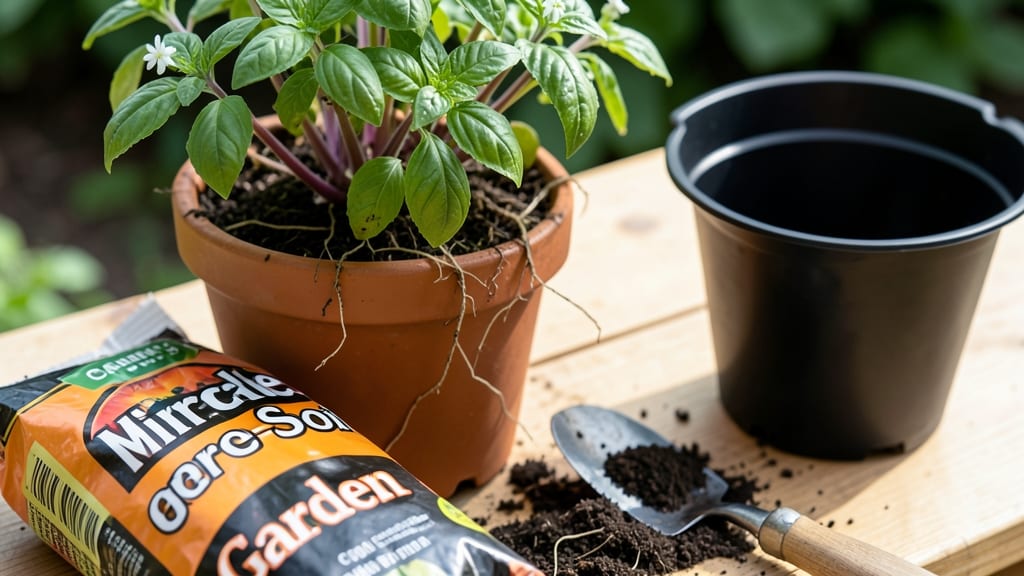
You can use Miracle-Gro Garden Soil in pots, but it requires careful mixing with perlite or coconut coir to prevent compaction and improve drainage. Using it straight from the bag risks suffocating roots and causing rot.
Miracle-Gro Garden Soil's heavy clay content makes it ideal for in-ground gardens where water can drain naturally, but containers need extra help. 🌱 The dense texture blocks airflow, trapping moisture against roots—especially problematic for plants like herbs or succulents that hate soggy conditions.
I've seen even experienced gardeners make this mistake, thinking "a little extra soil" would help, only to watch their potted plants wilt within weeks. The key is balancing that clay with 30-50% organic amendments to create pockets for air and water movement.
For best results, combine it with perlite (for lightweight aeration) or coconut coir (for moisture control), using a 1:1 ratio. This mimics the loose structure of premium potting mixes while keeping costs down.
Just remember: if your plant's leaves start yellowing or the soil smells musty, it's time to repot into a lighter blend immediately.
💡 In This Article
- Why Miracle-Gro Garden Soil Fails in Containers
- Best Soil Mixes for Potted Plants with Miracle-Gro
Why Miracle-gro garden soil fails in containers
Miracle-Gro Garden Soil's formula is optimized for in-ground planting where natural drainage and root expansion are less constrained. The blend typically contains 40-50% clay, which provides structure but becomes problematic in containers.
Clay particles pack tightly when watered, creating a dense matrix that suffocates roots by blocking oxygen flow—a condition known as anaerobic stress. In pots, this trapped moisture creates the perfect environment for fungal growth like Phytophthora, a root rot pathogen that thrives in waterlogged conditions.
The lack of organic matter exacerbates the issue. Standard potting mixes contain 20-30% peat moss or coconut coir, which holds moisture while allowing excess to drain.
Miracle-Gro's version often skips these components, forcing plants to compete for limited resources. 🌱 For comparison, a typical potting mix has a porosity of 50-60% (space for air and water), while Miracle-Gro's clay-heavy blend drops to 30-40%—a critical difference for root health.
This explains why container plants in unamended Miracle-Gro often show stunted growth or yellowing leaves within weeks.
Water retention becomes the real villain in pots. Clay holds 3-4 times more water than sandy soil, but containers have no room for excess to escape. When you water a pot with pure Miracle-Gro, the moisture sits at the bottom, creating a perched water table that drowns roots.
This is why even drought-tolerant plants like lavender or rosemary struggle—what works in the ground fails in containers. The solution lies in breaking up that clay structure with amendments that create air pockets while maintaining moisture retention.
Consider the texture difference: Miracle-Gro feels dense and slightly gritty when dry, while quality potting mixes have a light, almost fluffy consistency. This physical difference translates directly to plant performance.
For example, a basil plant in straight Miracle-Gro may develop blackened stems within 10 days, while the same plant in a 50/50 mix with perlite thrives for months. The clay's high cation exchange capacity (its ability to hold nutrients) becomes irrelevant when roots can't access oxygen.
Root health suffers most from this imbalance. Healthy roots need both oxygen (20-30% of soil volume) and water (20-30%), with the rest being solid particles. Miracle-Gro's clay-heavy formula often leaves less than 15% air space, forcing roots to work harder for nutrients while suffocating.
This explains why even nutrient-rich Miracle-Gro can't compensate for poor aeration—plants starve for oxygen long before they run out of food.
What most gardeners miss is how quickly this problem develops. Within 2-3 waterings, the clay particles begin to repack, reducing porosity by 15-25%. This is why repotting becomes necessary every 6-12 months when using Miracle-Gro in containers, even with amendments.
The clay's natural shrinkage-swell cycle (expanding when wet, contracting when dry) creates additional stress on delicate root systems in confined spaces.
The science behind this failure is rooted in soil physics. Clay particles have negative charges that attract water molecules, creating a hydrophilic matrix that resists drainage. In containers, this becomes a closed system where excess moisture has nowhere to go.
For reference, a 1-gallon pot of straight Miracle-Gro can hold up to 30% more water than its weight—far beyond what most container plants need. This excess moisture triggers anaerobic bacteria that produce ethylene gas, a plant hormone that accelerates aging and decay in roots.