
Container Gardens
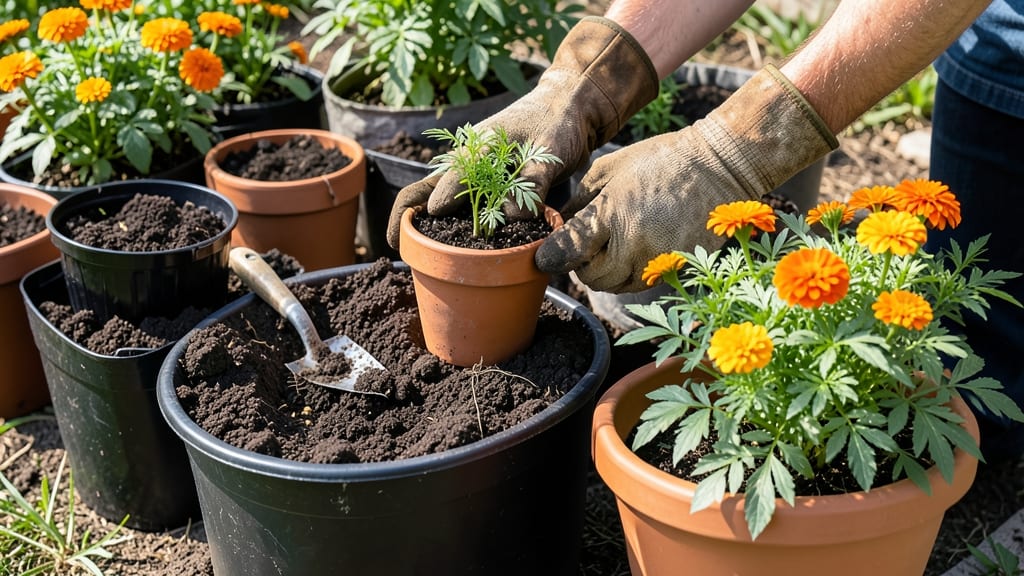
You can use raised bed soil in pots, but it risks compacting, poor drainage, and nutrient depletion over time, as potted plants require lighter, well-draining mixes with higher organic matter for root health and aeration.
Raised bed soil is heavier and denser than what potted plants need, often lacking the air pockets and organic matter that keep roots healthy in containers. 🌱 The compacted texture can suffocate roots, while the lack of proper drainage leads to waterlogging—a common killer of container-grown plants.
I've seen even hardy herbs like rosemary struggle when planted in garden soil mixes, so it's worth investing in a quality potting blend instead.
For best results, mix in perlite or vermiculite to improve aeration and add compost to boost nutrients. Commercial potting mixes already balance these elements, but DIY blends let you customize for specific plants. The key difference? Container soil should stay loose and crumbly, while garden soil clumps together when wet.
💡 In This Article
- Why Raised Bed Soil Fails in Containers
- Best Soil Mixes for Potted Plants
Why raised bed soil fails in containers
Raised bed soil is designed for in-ground planting where roots can spread freely and natural drainage occurs through the surrounding earth. In pots, however, the confined space creates a completely different environment.
The soil's natural density—often 1.2-1.5 grams per cubic centimeter—becomes problematic because it lacks the air pockets (10-30% porosity) that roots need to breathe.
Without these gaps, oxygen can't circulate properly, leading to anaerobic conditions that suffocate roots and invite fungal diseases like Phytophthora, which thrives in waterlogged soil.
The organic matter content also differs dramatically. Garden soil typically contains 2-5% organic material, while ideal potting mixes should have 40-70% organic matter (like peat moss or coconut coir) to retain moisture without compacting.
This higher organic content creates a looser structure that mimics the aeration of natural forest soil, where roots thrive. 🌱 When you use garden soil in pots, the lack of organic bulk means nutrients deplete faster—often within 3-6 months—because there's nothing to replenish the microbial activity that breaks down organic material into plant-available forms.
Drainage is another critical failure point. Raised bed soil often contains clay particles that swell when wet, reducing pore space by upstrong>50%. In pots, this means water pools at the bottom, creating a soggy layer where roots can't access oxygen.
Even plants like succulents or herbs that tolerate drought struggle because their roots can't escape the compacted zone.
I've seen basil plants in garden soil pots develop yellow leaves within 2 weeks due to root asphyxiation, while the same plants in a 50% perlite mix stayed vibrant for 3 months.
Nutrient availability shifts too. Garden soil relies on slow-release minerals from decomposed rock and organic matter, while potted plants need readily accessible nutrients. The confined space accelerates nutrient depletion because there's less soil volume to draw from.
For example, a 10-gallon pot filled with garden soil might provide enough nitrogen for 1 season, but the same pot with a proper potting mix can support plants for 2-3 seasons without fertilization.
The difference comes down to the soil's cation exchange capacity (CEC)—garden soil has a CEC of 10-30 meq/100g, while potting mixes can reach 50-100 meq/100g.
Even the microbial ecosystem differs. Garden soil hosts a diverse community of decomposers, but in pots, the lack of oxygen and moisture fluctuations create an environment where harmful bacteria like Erwinia (which causes soft rot) can dominate.
The closed system of a pot traps these pathogens, whereas in-ground plants benefit from natural dilution and aeration. 🔥 This is why I always recommend amending garden soil with 20% perlite or vermiculite and 10% worm castings if you must use it in containers—it helps mimic the microbial balance of natural soil while improving aeration.