
Orchid Care
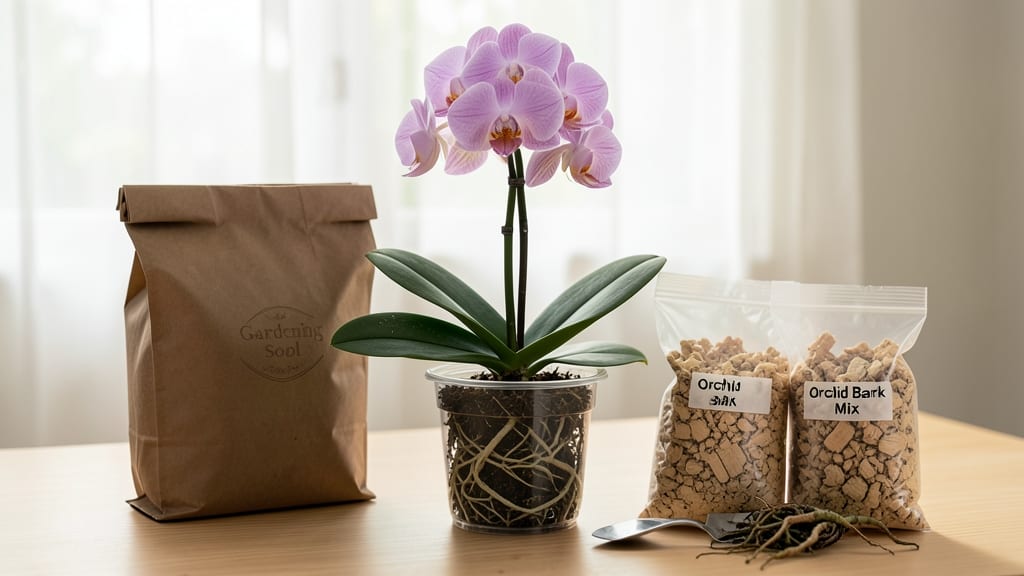
You shouldn't use regular potting soil for orchids because it compacts easily, traps excess moisture, and suffocates roots, leading to rot and fungal infections. Orchids need a loose, airy medium like bark, sphagnum moss, and perlite to replicate their natural growing conditions.
Orchids grow epiphytically in nature, clinging to trees and absorbing nutrients from air and rain—not dense soil. 🌿 Regular potting soil's heavy texture blocks airflow and holds water too long, creating the perfect environment for harmful bacteria.
A proper orchid mix lets roots breathe while still providing enough moisture retention for healthy growth.
Most garden soils are designed for terrestrial plants that thrive in dense, nutrient-rich environments. Orchids, however, have specialized roots that require circulation and drainage—qualities regular soil simply can't provide. Even well-draining potting mixes often lack the chunky structure orchids need to prevent waterlogging.
💡 In This Article
- Why Orchids Reject Regular Potting Soil
- DIY Orchid-Safe Soil Mix Recipes for Beginners
Why orchids reject regular potting soil
Orchid roots evolved to thrive in the canopy, where they cling to tree bark and absorb moisture from brief rain showers. Regular potting soil—packed with fine particles like clay, peat, and compost—creates a dense, water-logged environment that suffocates these delicate roots.
The compacted texture blocks oxygen flow, forcing roots to "drown" even when the soil appears dry on the surface. This is why orchids in standard soil often develop a grayish, mushy rot within weeks.
The key issue lies in moisture dynamics: regular soil holds water like a sponge, staying damp for days or even weeks. Orchid roots, however, need to dry out completely between waterings to prevent fungal infections.
A typical garden soil mix might retain 60-70% moisture capacity—far too much for orchids, which require mixes that drain to 30-40% capacity within 24 hours. This difference explains why even "well-draining" commercial soils often fail with orchids.
Nutrient density also plays a role. Standard potting soil contains high levels of slow-release fertilizers and organic matter designed for terrestrial plants. Orchids, however, absorb nutrients primarily through their leaves and roots in their natural habitat.
Excess nutrients in dense soil lead to salt buildup, burning delicate root tissues and stunting growth. The chunky bark and moss in proper orchid mixes release nutrients gradually, mimicking the slow nutrient flow orchids experience in the wild.
Consider the texture: regular soil particles are typically 0.25-2mm in diameter, creating a tight matrix that traps air pockets. Orchid mixes, however, use larger components like 3-10mm bark chunks and 5-15mm perlite granules, which create air channels that allow roots to breathe.
This structural difference is why orchids in proper mixes often develop vibrant green roots within weeks, while those in regular soil turn yellow or black from oxygen deprivation.
The science of root health reveals another critical factor: mycorrhizal relationships. Many orchids form beneficial symbiotic relationships with fungi in their natural environment. Dense soil disrupts these relationships by altering microbial communities, while the open structure of orchid mixes supports these natural partnerships.
Without proper airflow, beneficial microbes can't establish, leaving orchids vulnerable to pathogenic fungi like Phytophthora, which thrives in waterlogged conditions.
What most growers don't realize is how quickly problems escalate. Within 4-6 weeks of planting in regular soil, orchids often show early signs of distress: wilting leaves, yellowing foliage, or a foul smell from rotting roots. By this point, the damage is often irreversible.
The solution lies in recreating the orchid's natural environment—not just with the right ingredients, but with the proper balance of moisture, airflow, and nutrient availability that regular potting soil simply can't provide.