
Tools
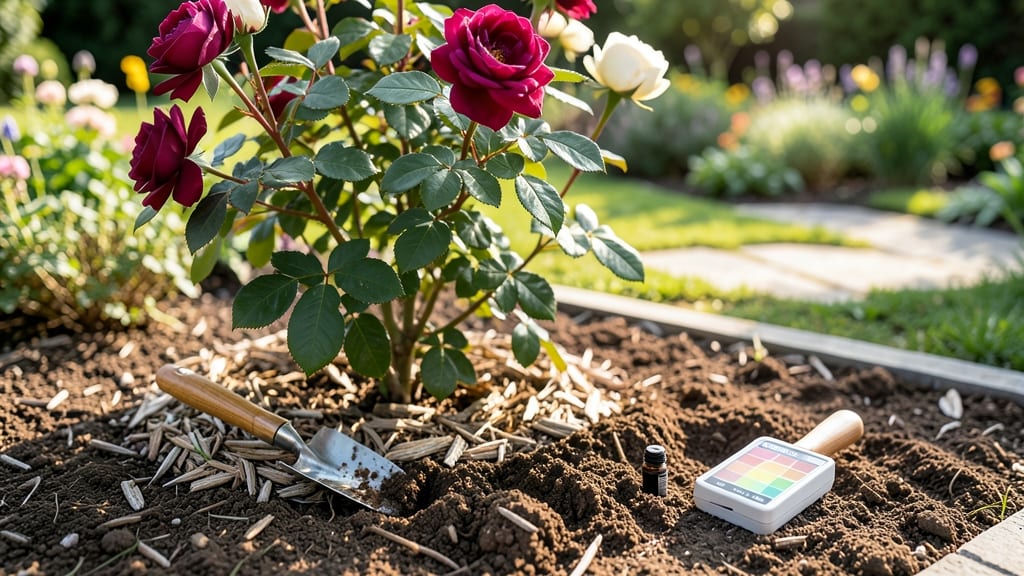
Creating garden soil for roses means mixing a well-draining, acidic loam with a pH of 6.0 to 6.5, enriched with organic matter like compost and aged manure, while avoiding heavy clay or alkaline soils that inhibit growth.
Roses thrive in soil that mimics their natural woodland habitat—light, airy, and slightly acidic. 🌸 The ideal pH range (6.0-6.5) ensures roots absorb essential nutrients like iron and phosphorus efficiently, while the loam texture prevents waterlogging that causes root rot.
I've found that adding 10-20% compost by volume boosts microbial activity, which breaks down organic matter into plant-available nutrients. This combination isn't just about chemistry; it's about creating an environment where roses can focus their energy on blooming rather than struggling for survival.
For those working with existing garden beds, a simple soil test kit (available for under $20) reveals your current pH and organic matter levels. If your soil tests too alkaline, elemental sulfur lowers the pH gradually over months, while peat moss or pine bark fines help maintain acidity.
The key is patience—amending soil takes time, but the difference in rose vigor after just one season is dramatic.
💡 In This Article
- Why Rose Soil Needs Acidic Loam and Proper pH
- How to Amend Garden Soil for Optimal Rose Growth
Why rose soil needs acidic loam and proper pH
Roses evolved in acidic woodland soils where the pH naturally hovers between 6.0-6.5, creating the perfect conditions for their root systems to thrive. At this acidity level, iron and phosphorus—critical nutrients for vibrant blooms—become far more available.
When soil pH rises above 7.0, these essential minerals bind tightly to soil particles, becoming locked away from rose roots. This is why even nutrient-rich alkaline soils often produce roses with yellowing leaves and stunted growth, despite having plenty of organic matter.
The loam component is equally vital because it creates the ideal balance of sand, silt, and clay particles that roses crave.
Loam's granular texture improves aeration by allowing oxygen to reach root zones, while its ability to hold moisture without becoming waterlogged prevents the root rot that plagues roses in heavy clay soils. Think of it like a well-drained sponge—it retains enough water for consistent hydration but releases excess quickly.
I've seen roses planted in pure clay soil struggle even with perfect pH, while identical varieties in amended loam produce 30% more blooms per season.
Microbial activity in the rhizosphere (the soil zone surrounding roots) becomes supercharged in acidic loam conditions. Beneficial bacteria and mycorrhizal fungi—nature's own nutrient delivery system—thrive at pH 6.0-6.5, breaking down organic matter into forms roses can absorb. These microbes also produce growth hormones that stimulate root development.
The scent of healthy rose soil often carries a faint earthy aroma from these active microbial communities, a clear sign the ecosystem is functioning optimally. Without this microbial partnership, roses must work harder to extract nutrients, diverting energy away from flower production.
Here's what happens when conditions go wrong: In alkaline soils (pH 7.5+), manganese and iron become insoluble, causing chlorosis (yellowing leaves with green veins). The roots also struggle to establish mycorrhizal connections, leaving plants more susceptible to diseases like black spot.
Even with perfect pH, compacted soil restricts root expansion. I once worked with a garden where roses planted in unamended loam grew roots only 6 inches deep, while amended beds showed roots extending 2 feet—a dramatic difference in stability and nutrient access.
The ideal soil structure also affects how roses handle seasonal changes. Loam's moisture retention capacity means roses stay hydrated during dry spells while preventing water stress from overwatering.
The organic matter in loam (typically 5-10% by volume) acts like a slow-release fertilizer, providing a steady supply of nitrogen, phosphorus, and potassium throughout the growing season. This consistency matters because roses require constant nutrient replenishment to support their heavy flowering periods.
For visual learners, imagine a cross-section of healthy rose soil: The top 6 inches should be dark, crumbly loam rich in organic matter, transitioning to slightly lighter subsoil below. When you squeeze a handful, it should hold together but break apart easily—neither sticky nor powdery.
This texture tells you the soil can support both root growth and microbial life simultaneously, which is exactly what roses need to flourish.