
Light Requirements
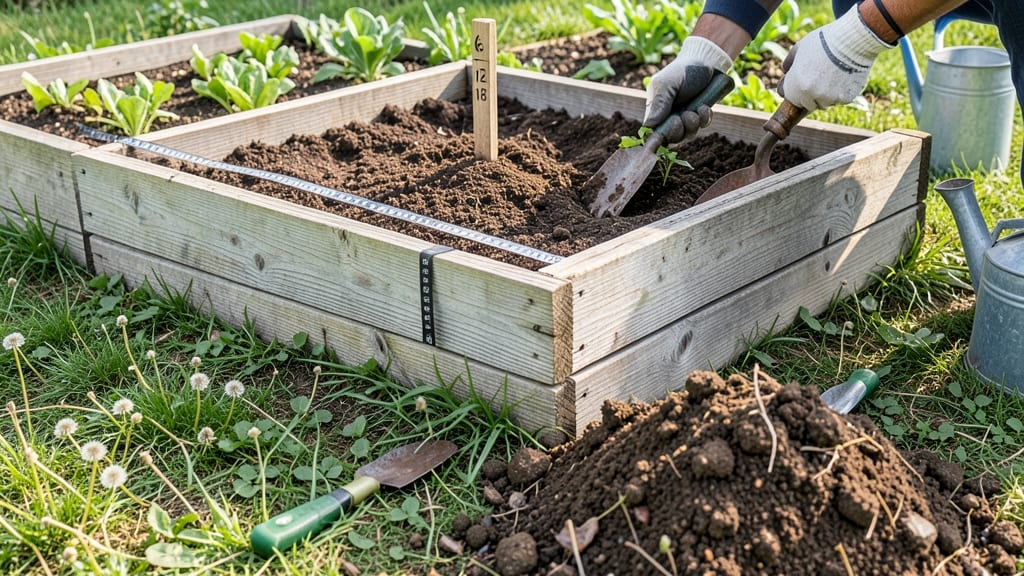
To calculate how much soil needed for a raised bed, multiply the bed's length × width × depth (in feet) to find cubic feet, then add 10% extra to account for soil settling. For a standard 4’x8’ bed with 12” depth, you'll need approximately 32 cubic feet of soil before compaction.
This calculation ensures your plants have enough space to grow without running out of nutrients. Depth matters too—most vegetables need at least 12 inches of soil, while deeper beds (18+ inches) support root crops like carrots or potatoes better. 🌱 I always recommend buying 10-15% more soil than calculated, since settling can reduce usable space by up to 20% after watering.
For larger beds, consider breaking the order into two shipments to avoid waste if you don't use it all immediately.
Another key factor is soil type. Pure topsoil compacts easily, while a mix of topsoil, compost, and perlite improves drainage and aeration. If your bed is wider than 4 feet, divide it into sections with pathways to prevent soil compaction from foot traffic.
This also makes maintenance easier and reduces erosion during watering.
💡 In This Article
- Calculating Raised Bed Soil Volume by Depth and Size
- Best Soil Mixes and Layering for Raised Garden Beds
Calculating raised bed soil volume by depth and size
The core of calculating soil volume lies in understanding cubic feet—the three-dimensional space your raised bed occupies. Start by converting all measurements to feet: a 4-foot-wide bed remains 4 feet, but a 12-inch depth becomes 1 foot (12 ÷ 12 = 1).
Multiply length × width × depth to get the raw volume. For our 4’x8’x1’ example, that’s 4 × 8 × 1 = 32 cubic feet. This formula works because soil volume follows the same geometric principles as any rectangular container, whether it’s a wheelbarrow or a skid loader’s payload.
Depth is where things get interesting for plant health. Most vegetables thrive with 12 inches (1 foot) of soil, but root crops like carrots or potatoes need 18-24 inches (1.5-2 feet) to develop properly.
That extra depth translates directly to more soil volume—our 4’x8’ bed jumps from 32 to 48 cubic feet when doubled in depth. The deeper you go, the more dramatic the soil requirement becomes because you’re multiplying by an additional foot.
For example, a 3-foot-deep bed (common for intensive gardening) would require 96 cubic feet of soil for the same footprint.
Here’s where settling becomes critical: fresh soil compresses by 10-20% after watering, especially if it’s heavy clay or topsoil. This isn’t just about having extra bags—it’s about root space. Imagine planting a carrot seed in soil that compacts from 12 inches to 9 inches after your first watering.
The roots hit the bed’s bottom before reaching maturity. That’s why I always recommend adding 10-15% extra soil to your calculation. For our 32-cubic-foot example, that means ordering 36-38 cubic feet to ensure you have enough after settling.
Real-world dimensions reveal common patterns. A 2’x6’ bed at 12” depth needs 12 cubic feet, while a 4’x4’ bed at 18” depth requires 24 cubic feet. Notice how the smaller footprint doesn’t always mean less soil—depth often dominates the calculation.
Pro tip: measure your bed’s interior dimensions (not the lumber thickness) to avoid overestimating. Many gardeners mistakenly use outer dimensions, which can lead to buying 20% more soil than needed if the bed frame is thick.
Soil type affects volume too. Lightweight mixes (like 60% topsoil + 30% compost + 10% perlite) settle less than pure topsoil because of better aeration. Conversely, clay-heavy soils can compact by up to 30%.
If you’re mixing your own soil, account for this by adding even more bulking agents like coconut coir or vermiculite. For example, a 4’x8’x1’ bed filled with a fluffy compost blend might need 40 cubic feet instead of 32 to maintain the same post-settling depth.
Visualize this with a 1-yard bag of soil, which equals 27 cubic feet. That’s enough for a 3’x3’x3’ cube—perfect for a single deep bed. But if you’re filling multiple beds, you’ll quickly see why bulk orders (like 1 cubic yard pallets) make more sense.
Always check the bag’s labeled volume too—some brands round up, while others understate to save on shipping costs. A 12-cubic-foot bag might actually deliver only 10 cubic feet after settling, leaving you short for larger projects.