
How To
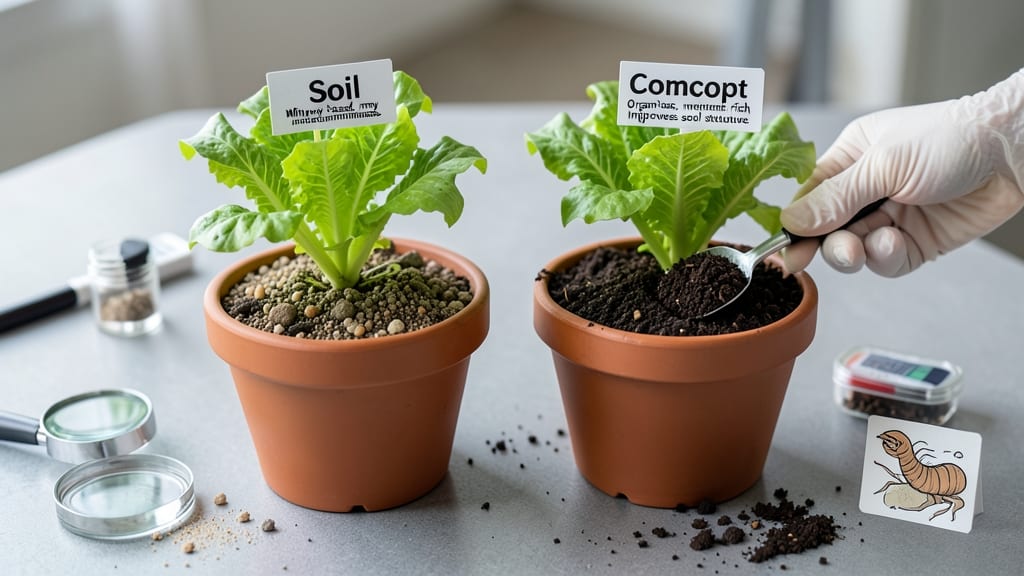
Soil and compost are not the same thing: soil provides the foundational growing medium for plants, containing minerals, organic matter, and beneficial microbes, while compost is a nutrient-rich amendment made from decomposed plant materials that enhances soil fertility and structure.
Soil is the foundation where plants anchor their roots and thrive, packed with minerals, organic debris, and microscopic life that break down nutrients into plant-available forms.
Compost, on the other hand, is like a supercharged fertilizer—it’s primarily decomposed kitchen scraps, yard waste, and other organic materials that boost soil health by improving water retention and aeration. 🌱 Think of soil as the house and compost as the premium renovation that makes it more livable for your plants.
While they serve different purposes, they work together beautifully. For example, adding compost to depleted garden soil revives its vitality, while soil provides the stable environment where compost’s nutrients can do their magic.
I’ve found that mixing them in a 2:1 ratio (soil to compost) creates the perfect balance for container plants or vegetable gardens.
💡 In This Article
- How Soil and Compost Differ in Composition and Function
- When to Use Soil vs Compost in Gardening Projects
How soil and compost differ in composition and function
At their core, soil and compost differ dramatically in their makeup. Soil is a complex ecosystem containing roughly 45% minerals (like sand, silt, and clay), 25% water, 25% air, and 5% organic matter.
This mineral base provides the structural foundation plants need to anchor roots and access nutrients.
Meanwhile, compost is 90% organic matter—decomposed plant materials, microbes, and fungi—that acts as a nutrient powerhouse rather than a structural base. 🌱 The key difference lies in their roles: soil holds plants up, while compost feeds them.
Microbial activity is another critical distinction. Healthy soil teems with 1 billion microorganisms per teaspoon, including bacteria, fungi, and protozoa that break down organic matter into plant-available nutrients.
Compost, however, is where this decomposition process begins—it’s essentially a concentrated source of partially decomposed materials that haven’t yet reached soil’s mature state. The microbial populations in compost are different too: they’re more focused on breaking down fresh organic waste rather than maintaining a balanced ecosystem like soil microbes do.
Water retention and aeration highlight their functional differences. Soil’s mineral composition creates pores that balance water drainage and air circulation—critical for root respiration.
Compost, with its high organic content, holds 3-4 times more water than mineral soil, which makes it ideal for drought-prone areas but can suffocate roots if used alone. The trade-off? Pure compost compacts easily when wet, while soil’s mineral structure maintains better aeration for root systems.
This is why gardeners often mix them in 3:1 or 2:1 ratios (soil to compost) to optimize both functions.
Nutrient availability offers another layer of contrast. Soil minerals release nutrients slowly through weathering, while compost provides a rapid nutrient boost from decomposed materials. For example, compost can deliver 1-2% nitrogen, 0.5-1% phosphorus, and 0.5-1% potassium by weight, compared to soil’s more gradual nutrient release.
This makes compost perfect for quick plant growth spurts, while soil’s steady nutrient supply supports long-term plant health. The synergy occurs when compost amends soil, creating a system where both provide what the other lacks.
Consider the texture: soil feels gritty from minerals, while compost has a crumbly, almost spongy texture from decomposed plant fibers. This physical difference affects how plants interact with each medium. Roots spread easily through soil’s stable structure but may struggle in pure compost, which can become too dense.
Conversely, compost’s high organic content improves soil’s ability to hold nutrients and moisture, making it an essential amendment rather than a replacement. 🌿
The pH balance also varies significantly. Most soils range from 5.5 to 7.5 (slightly acidic to neutral), while fresh compost is often 6.5 to 8.5 (neutral to slightly alkaline). This difference matters because certain plants thrive in acidic conditions (like blueberries) while others prefer neutral or alkaline soil (like lavender).
When using compost, it’s wise to test your soil first—amending with compost can shift pH over time, especially in sandy soils that drain quickly.
Finally, think about their lifespans. Soil remains stable for decades, while compost continuously breaks down—losing nutrients over 1-3 years unless replenished. This is why gardeners top-dress with fresh compost annually rather than relying on it as a permanent growing medium.
The relationship between soil and compost is symbiotic: compost revitalizes soil, while soil provides the stable environment where compost’s benefits can fully manifest. 💫