
How To
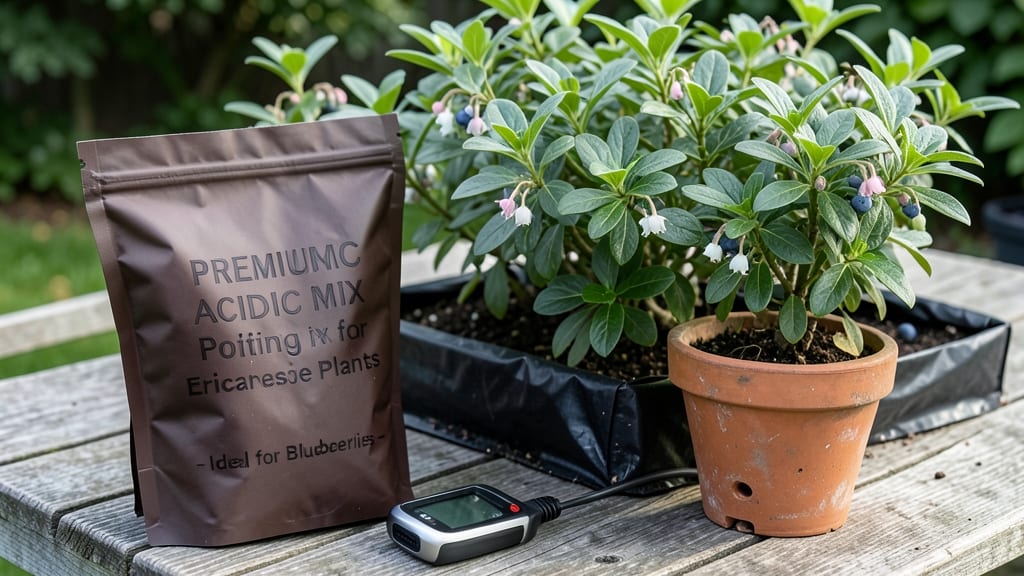
The right potting soil for blueberries turns a container into a fruit-producing powerhouse. 🌿 Blueberries demand acidic soil between pH 4.5-5.5, and most garden soil is way too alkaline—here’s how to fix that.
Start with a mix of peat moss or coconut coir (for acidity), pine bark fines (for aeration), and composted pine needles (for slow-release acidity). Avoid garden soil, compost, or lime—these raise pH and stunt growth.
A 50/50 blend of peat moss and pine bark works well, but test your soil first. Your plants will reward you with larger berries and deeper blue color within a season.
The secret is consistency: refresh the top 2 inches of soil yearly with sulfur or sphagnum peat to maintain acidity. This method works for dwarf, semi-dwarf, and standard varieties—just adjust container size. Let’s get those blueberries thriving!
📚 In This Guide
- What you need
- Instructions
- Tips and common mistakes
- Wrapping up and next steps
What you need
- ● Peat moss or coconut coir: 50% of the mix (holds moisture, mimics acidity). Pro tip: Coconut coir is eco-friendly!
- ● Pine bark fines: 25% (improves aeration and drainage). Look for finely shredded bark, not chunks.
- ● Perlite or vermiculite: 25% (lightens the mix, prevents compaction). ✨ Perlite adds extra air pockets!
- ● Acid-loving fertilizer: 1 tbsp per gallon of mix (e.g., Osmocote or Miracle-Gro Azalea/Camellia). Must be low in phosphorus!
- ○ Lime-free compost: 10% (optional but adds nutrients). Avoid any compost with limestone.
- ● Gloves & dust mask: Protect yourself from peat moss and perlite dust.
- ● Large mixing bin or wheelbarrow: At least 5-gallon capacity for easy blending.
- ● Garden trowel or shovel: For stirring and layering.
- ● pH testing kit: Critical! Aim for pH 4.5–5.5. Adjust with sulfur if needed.
- ● Containers with drainage holes: 10–12 inches deep for dwarf varieties, 16+ inches for standard bushes.
- ● Worm castings: 5% boosts microbial life (great for nutrient uptake!).
- ● Sphagnum peat moss: Adds extra moisture retention (ideal for hot climates).
- ● Blueberry-specific soil additive: Pre-mixed blends (like FoxFarm Ocean Forest) save time!
- ● Slow-release sulfur: If your mix tests too alkaline (pH >6.0).
Step-by-Step guide to creating the perfect potting soil for blueberries
Here's my foolproof method for crafting an acid-loving blend that delivers plump, flavorful berries every season.
🌱 Step 1: Combine Base Materials for Proper Drainage and Aeration
Start with 50% peat moss or coconut coir—this gives your blueberries the acidic environment they crave. I always use coconut coir when possible because it's more sustainable and holds moisture better than peat. Add 30% pine bark fines next; these create air pockets that prevent root rot while maintaining structure.
Mix these two components thoroughly in a large container or wheelbarrow. The pine bark should look evenly distributed throughout the peat, with no clumps larger than your fist. This blend alone won't support blueberries long-term, but it forms the perfect foundation. I like to work in batches of 4 cubic feet at a time for consistency.
🌿 Step 2: Incorporate Organic Matter for Nutrient Density
Add 15% composted pine needles—this is crucial for maintaining acidity. I collect these from my yard after they've decomposed for at least 6 months, or I buy pre-composted needles from a garden center. Next, blend in 5% worm castings for gentle, slow-release nutrients. These won't just feed your plants; they'll improve soil structure and microbial activity.
Use your hands to gently fold these amendments into the base mix. You'll notice the texture becomes slightly grittier and darker. This is good—it means your soil now has the organic matter blueberries need to thrive. Avoid over-mixing; just break up any remaining clumps until the blend looks uniformly dark brown with visible needle fragments.
💧 Step 3: Add Acid-Forming Amendments and Conditioners
Sprinkle 1 cup of sulfur per 4 cubic feet of mix—this is the secret weapon for maintaining that critical pH 4.5-5.5 range. Work it in thoroughly but gently to avoid creating dust. Next, add 1/2 cup of azalea/blueberry fertilizer per 4 cubic feet. This specialized fertilizer contains micronutrients like iron and manganese that blueberries need but most regular fertilizers lack.
For the final touch, incorporate 1/4 cup of perlite per 4 cubic feet. This ensures proper drainage while preventing compaction. The perlite will look like tiny white pebbles throughout the mix. I always test the moisture level at this stage by squeezing a handful—it should hold together when pressed but not drip water. If it's too dry, lightly mist with water until evenly moist.
✂️ Step 4: Test and Adjust Before Use
Use a soil pH test kit to check your mix. The ideal reading should be between 4.5-5.5. If it's higher than 5.5, add more sulfur and remix thoroughly. For every 0.5 pH unit too high, add an additional 1/4 cup of sulfur per 4 cubic feet. I've found that most homemade mixes need about 1/2 cup extra sulfur to reach the perfect range.
Give your mix a final inspection for consistency. It should look dark, crumbly, and slightly acidic-smelling (like fresh pine needles). Fill your containers with this blend, leaving 1 inch of space at the top for watering. Water thoroughly until it drains from the bottom, then let it sit for 24 hours before planting. This settling period prevents root shock when you transplant your blueberries.
Tips & tricks for perfect acid-loving blueberry soil
Between us, the secret to blueberries that burst with flavor starts with soil that mimics their natural habitat. Here's what I've learned after years of trial and error.
Base Material Balance: When combining the 50% coconut coir and 30% pine bark fines in Step 1, don't just eyeball it—use a measuring tape to mark your container's dimensions. For a 4 cubic feet batch, you'll need roughly 2 cubic feet of coir and 1.2 cubic feet of bark. This precise ratio ensures proper aeration while maintaining that essential acidity. I've found that using a wheelbarrow with marked lines makes mixing these components much easier.
Needle Decomposition Check: In Step 2, those composted pine needles must be fully decomposed—no visible chunks! If you're collecting your own, spread them on a tarp in a shaded area for 6 months before using. For pre-composted needles, check the package date—anything older than 2 years might have lost its acidifying properties. The needles should crumble easily between your fingers like dark brown sand.
Sulfur Application Technique: When adding the 1 cup of sulfur in Step 3, sprinkle it evenly over the entire mix rather than piling it in one spot. Use a fine-mesh strainer to distribute it more evenly, which prevents sulfur dust from creating hot spots that could burn plant roots. After mixing, let the blend sit for 10 minutes before testing pH—this gives the sulfur time to fully integrate.
Perlite Proportion: That 1/4 cup of perlite per 4 cubic feet might seem small, but it's crucial for preventing compaction. If you're working with larger batches, scale this proportion exactly—too little perlite leads to heavy, compacted soil that suffocates roots. I like to pre-mix the perlite with a small amount of the base blend before incorporating everything else to ensure even distribution.
Pro Tips for Potting Soil For Blueberries
- Between us, the secret to blueberries that burst with flavor starts with soil that mimics their natural habitat.
- Base Material Balance: When combining the 50% coconut coir and 30% pine bark fines in Step 1, don't just eyeball it—use a measuring tape to mark your container's dimensions.
- Needle Decomposition Check: In Step 2, those composted pine needles must be fully decomposed—no visible chunks!
Frequently asked questions
Got questions about potting soil for blueberries?
You’re not alone! Here are answers to the most common concerns—from soil pH to troubleshooting—so you can grow juicy, bountiful berries with confidence.
What’s the best pH range for blueberry potting soil?
Blueberries thrive in acidic soil with a pH between 4.5 and 5.5. Test your soil’s pH before planting—most garden centers sell affordable kits. If your mix is too alkaline, amend it with sulfur or peat moss to lower the pH gradually. Never use lime or wood ash!
How often should I repot blueberries in acidic soil?
Repot every 2–3 years to refresh nutrients and prevent compaction. Spring is ideal! If roots circle the pot, it’s time to upgrade—choose a container 1–2 inches larger than the current one. Pro tip: Add a 1-inch layer of fresh acidic potting mix on top annually for a nutrient boost.
Can I use regular potting soil for blueberries?
Nope! Regular potting soil is usually too alkaline (pH 6.0–7.0) for blueberries. Instead, blend 50% peat moss or coconut coir (for acidity) with 30% pine bark fines (for aeration) and 20% perlite or sand (for drainage). Pre-mixed blueberry-specific mixes save time!
Why are my blueberries small or tart, even with the right soil?
Small/tart berries often signal nutrient deficiencies (like nitrogen or phosphorus) or overwatering. Check your soil’s moisture—it should stay consistently damp but not soggy. Feed with an acid-loving plant fertilizer (like 10-10-10) in early spring and mid-summer. Yellow leaves? Boost iron with chelated iron supplements.
What’s a quick fix if my potting mix loses acidity over time?
Over time, potting soil buffers pH. To reset acidity, mix in 1–2 cups of sphagnum peat moss or pine fines per gallon of soil. For a fast fix, water with vinegar diluted to 1 part vinegar per gallon of water (use white vinegar, not apple cider). Re-test pH after 2 weeks!
Are expensive blueberry mixes worth it?
Premium mixes (like FoxFarm Ocean Forest or Black Gold Blueberry) are convenient but not always necessary. DIY blends with peat moss, pine bark, and perlite work just as well for $10–$15 per cubic foot. Save money by reusing old soil (sterilized with hydrogen peroxide) and topping it with fresh acidic mix.
Wrapping up and next steps
Choosing the right potting soil for blueberries is the secret to thriving plants and mouthwatering harvests! 🌱 With an acid-loving blend rich in organic matter and proper drainage, you’re setting your blueberries up for success.
Remember, pH matters—keep it between 4.5 and 5.5—and don’t forget to refresh the soil every few years for peak performance.
Now that you’re armed with the knowledge, it’s time to roll up your sleeves! Grab your supplies, mix that perfect blend, and watch your blueberry bushes flourish. Happy gardening—your future blueberry pies will thank you! 🍰