
How To
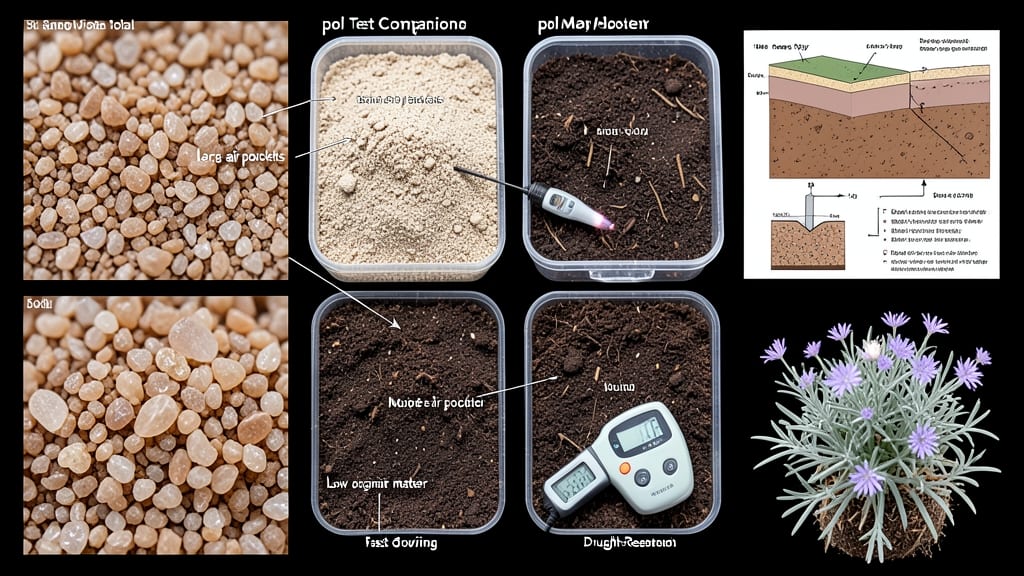
This sandy soil definition describes a coarse-textured soil type where large, loosely packed sand particles dominate, creating rapid water drainage and poor nutrient retention for plant roots. This gritty composition, combined with minimal organic material, typically requires amendments to support healthy plant growth.
A sandy soil definition explains that it forms when rocks break down through weathering and erosion, leaving behind coarse particles that don't clump together. 🌱 Unlike clay or loam, its large grains create big air pockets, which help drainage but make it hard for roots to hold onto water and nutrients.
This is why many gardeners struggle to grow plants in pure sand—it's like trying to water a sieve. The key to working with sandy soil lies in adding organic matter like compost or peat moss to improve its structure and fertility.
Most plants prefer soil that balances drainage with moisture retention, which is why sandy soil often needs amendments. Deep-rooted plants like lavender or drought-resistant varieties can thrive, but adding organic materials helps create a more balanced growing medium.
The goal is to mimic loamy soil's ideal texture—where water and nutrients stay available while excess drains away.
💡 In This Article
- How Sandy Soil Forms and Its Geological Composition
- Improving Plant Growth in Sandy Soil Gardens
How sandy soil forms and its geological composition
Sandy soil begins its life as larger rock formations that undergo physical and chemical weathering—a slow process where wind, water, and temperature changes break rocks into smaller fragments. These fragments, primarily quartz and feldspar, eventually erode into particles ranging from 0.05 to 2 millimeters in diameter.
What sets sand apart is its coarse texture, where particles are too large to cling together, creating a loose, gritty structure.
Unlike clay soil (with particles <0.002mm) or loam (a balanced mix), sand lacks the tiny spaces that hold water and nutrients, making it behave more like a sieve. 🌊
This particle size distribution directly impacts drainage: water moves through sandy soil at a rate of 5-10 inches per hour, compared to just 0.2-2 inches per hour in loam. The rapid drainage occurs because large sand grains leave 30-40% air pockets, preventing water from lingering near roots.
Geologists classify sandy soil as "entisols" or "psamments" when it's newly formed, often found in coastal areas, riverbeds, or deserts where erosion deposits sand layers. The lack of organic matter (typically <1%) further reduces its fertility, as nutrients like nitrogen and phosphorus wash away quickly.
What makes sandy soil unique is its mineral composition: about 90% quartz, which is chemically inert, plus small amounts of feldspar, mica, and occasional shells or rock fragments.
This mineral makeup explains why it feels coarse to the touch—rubbing a handful between fingers reveals its gritty, almost powdery texture. In contrast, clay soil feels sticky when wet due to its tiny, plate-like particles that clump together.
The high silica content in sand also means it heats up faster in sunlight, which can stress plant roots if not managed properly. 🔥
One critical factor in sandy soil's behavior is its bulk density—typically 1.5-1.7 grams per cubic centimeter, which is higher than loam (1.2-1.4 g/cm³). This means it's more compacted, even though it feels loose, because the large particles don't create stable aggregates.
The absence of organic binding agents (like humus in loam) prevents the formation of crumb structure, making it difficult for roots to anchor. For example, a 1-gallon container of sandy soil might hold only 50% of the water that loam would, demonstrating its poor water-holding capacity.
Understanding these geological traits helps explain why sandy soil often appears in young landscapes or areas with recent geological activity. For instance, the dunes of Cape Cod or the desert sands of the Sahara formed through aeolian (wind-driven) processes, where sand grains are transported and deposited in layers.
In agricultural terms, this means sandy soils are common in glacial outwash plains or alluvial fans, where rivers deposit coarse sediments during floods. The challenge for gardeners lies in mimicking nature's slow process of soil development by adding organic matter to improve structure and fertility. ✨
Consider this comparison: while loam soil retains 30-60% of its water content after drainage, sandy soil may lose 90% or more within hours. This extreme variability is why plants in sandy soil often exhibit wilting between waterings—their roots can't access moisture quickly enough.
The solution lies in amending the soil to create a more balanced medium, where water and nutrients can be stored while excess drains away efficiently. 💫