
Tools
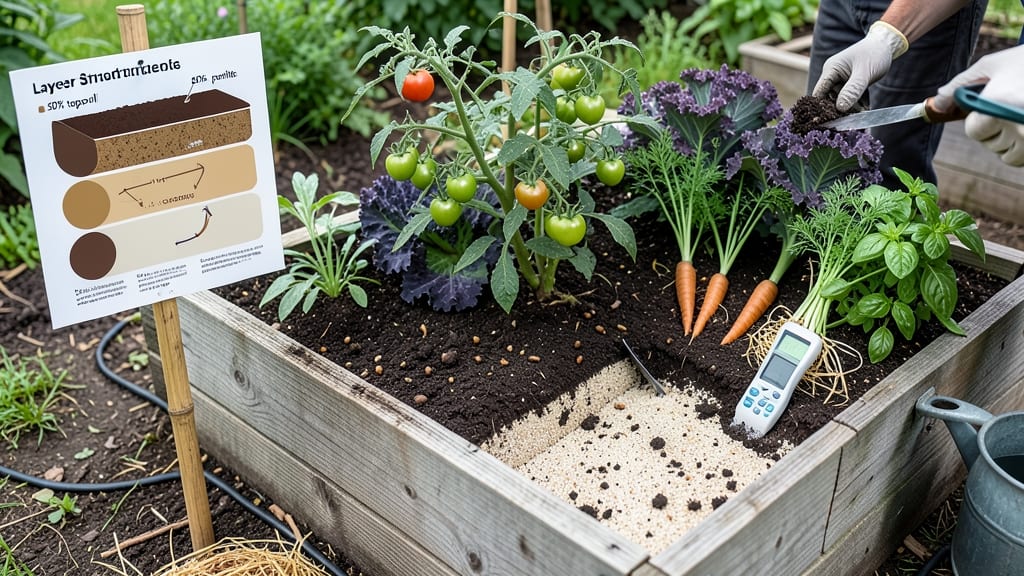
The soil composition for a raised vegetable garden should be a balanced mix of 40% sand, 40% silt, and 20% clay (loamy soil), which promotes drainage while holding moisture and nutrients for healthy plant growth. Fine-tune the mix based on your local soil's natural clay content or drainage challenges.
A loamy soil mix works best because it creates the perfect balance between air pockets (from sand) and moisture retention (from silt and clay). 🌱 This structure prevents waterlogging while ensuring roots get consistent hydration—critical for vegetables like tomatoes and peppers that need steady nutrients.
If your area has heavy clay, adding 20-30% coarse sand helps break up compaction, while sandy soils benefit from compost or peat moss to boost nutrient density. Always test your soil first: a simple jar test (layering soil with water) reveals your natural ratios in minutes.
For root crops like carrots, aim for slightly more sand (45%) to prevent forking, while leafy greens thrive in richer mixes with extra compost. Heavy feeders like squash appreciate a 50-50 loam-to-compost blend for sustained growth.
The key is adapting the base loam formula to your plants' specific needs—whether that means adding perlite for aeration or worm castings for microbial activity.
💡 In This Article
- Why Loam Soil Dominates Raised Garden Success
- Customizing Raised Garden Soil Mixes for Different Vegetables
Why loam soil dominates raised garden success
The magic of loam soil lies in its particle structure: sand creates air pockets for oxygen flow, silt holds moisture like a sponge, and clay binds nutrients like a magnet.
This trifecta gives roots the perfect environment—sand prevents suffocation, while silt and clay work together to store water and minerals. 🌱 For example, a loam mix with 40% sand ensures roots breathe easily, while the 20% clay component clings to essential nutrients like nitrogen and phosphorus, releasing them gradually as plants need them.
Compare this to pure sand, which drains too quickly (like a sieve), or heavy clay, which suffocates roots by compacting into a brick-like barrier. Loam's 40% silt acts as the balancing act—it holds water near plant roots but drains faster than clay alone, preventing root rot.
This is why vegetables like tomatoes thrive in loam: their deep roots need both oxygen and steady hydration, which loam delivers perfectly. In contrast, clay-heavy soils often require 20-30% sand to break up compaction, while sandy soils need compost or coconut coir to boost nutrient retention.
What most gardeners overlook is how these particles interact at a microscopic level.
Clay particles are negatively charged, attracting positively charged nutrients (like calcium and magnesium), while sand's rough texture creates tiny channels for water and air movement. 💫 The silt fraction, with its smooth, flat surfaces, acts as a buffer—absorbing excess water during rains and releasing it slowly during dry spells.
This tripartite system is why loam can hold 50% more water than sand but still drain 30% faster than clay.
For raised beds, this structure becomes even more critical because you're working with a controlled environment. Without proper aeration, roots suffocate; without moisture retention, plants wilt. Loam's ability to maintain 60-70% porosity (the space between particles) ensures roots can grow freely while accessing both water and oxygen.
This is why professional growers often specify loam mixes for high-value crops—they know the science behind why plants grow 20-30% faster in ideal loam compared to suboptimal soil.
Consider this real-world example: In a 10-gallon raised bed, a loam mix will maintain moisture for 3-5 days between waterings, while pure sand might dry out in 12 hours.
The difference comes down to that silt-clay interaction—clay holds water via capillary action, while silt stores it in its microscopic pores. This dual mechanism is why loam feels rich yet crumbly when you squeeze it: it collapses slightly (indicating good drainage) but doesn't fall apart completely (showing moisture retention).
One common mistake is assuming all loam is equal. Local clay content varies wildly—some regions have naturally 30% clay, while others have almost none. Always test your native soil first: mix a handful with water in a jar, shake, and observe the layers.
If you see more than 20% clay (the bottom layer), add sand; if it's mostly sand (top layer), incorporate compost. This simple test reveals whether your garden needs a sand boost or a nutrient-rich amendment to achieve that perfect loam balance. ✨