
Landscaping
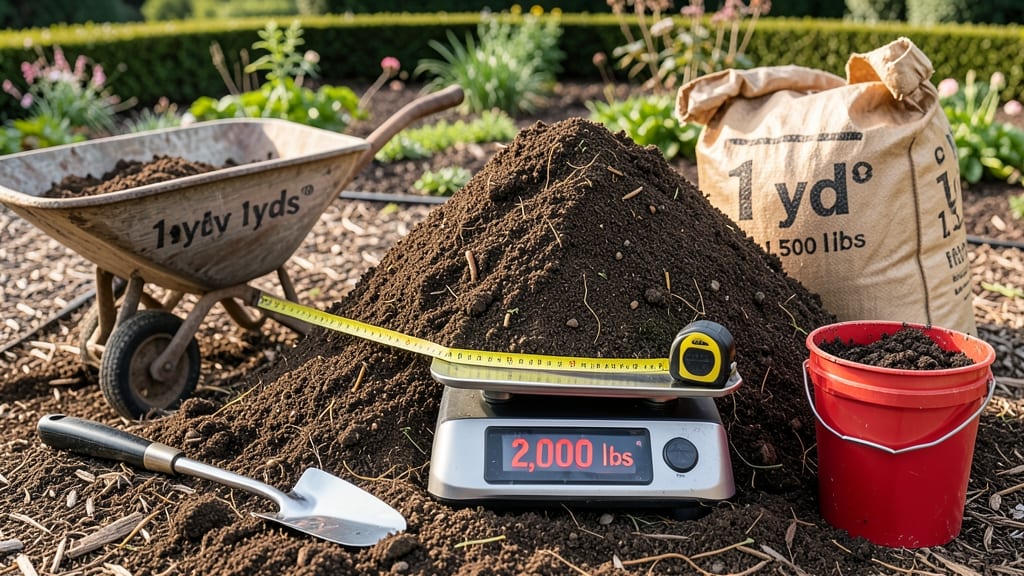
One yard of soil weighs between 1,800 to 2,200 pounds, depending on its density and moisture content—sandy soil leans toward the lighter end, while clay-heavy or loamy soil approaches the heavier range. Compacted or wet soil can exceed 2,500 pounds per cubic yard.
Understanding how much soil weighs helps with everything from truckload estimates to garden planning.
The weight varies dramatically based on what's in your soil—sand particles pack loosely, while clay particles bind tightly, increasing density. 🌱 For example, a typical loamy soil (the ideal mix for gardens) usually falls in the 2,000-pound range, while peat-based soils can weigh less due to their high organic content.
Even a small change in moisture can swing the scale by hundreds of pounds, so always account for recent rain or irrigation when calculating.
This variation matters most when ordering bulk materials. A pickup truck might carry 1–2 cubic yards, but its payload capacity (often 1,500–2,000 pounds) could be exceeded by heavy clay soil. I always recommend checking with your supplier—they can help adjust quantities based on your specific soil type and project needs.
💡 In This Article
- Soil Density Types and Their Weight Variations
- Calculating Soil Weight for Gardening Projects
Soil density types and their weight variations
Soil weight varies dramatically because of its fundamental structure—particle size, composition, and how tightly those particles pack together. Sandy soil, with its large, coarse particles, typically weighs 1,400–1,600 pounds per cubic yard because the grains don't bind well, leaving lots of air pockets.
In contrast, clay soil contains tiny, flat particles that stack tightly, creating a dense matrix that can push weights to 2,400–2,600 pounds per cubic yard. The difference comes down to porosity: sand acts like a loose sponge, while clay behaves more like a compacted brick.
Loamy soil—the gardener's gold standard—falls right in the middle, usually weighing 1,800–2,200 pounds per cubic yard. This ideal mix combines sand, silt, and clay with organic matter, creating a balanced structure that holds moisture while allowing airflow.
Organic soils like peat moss are the lightest, often weighing 800–1,200 pounds per cubic yard, because their fibrous structure traps air rather than dense minerals. Even a small addition of organic compost can reduce overall density by up to 20% compared to pure mineral soil.
The moisture content adds another layer of complexity. Dry soil weighs significantly less than saturated soil—adding water can increase weight by 10–30% because water itself weighs 8.34 pounds per gallon.
For example, a cubic yard of sandy soil might jump from 1,500 pounds dry to 1,900 pounds when wet. This is why landscapers always ask about recent rainfall when estimating deliveries. Even a light rain can transform a manageable load into a heavy burden that requires extra equipment.
Compaction plays a critical role too. Foot traffic or machinery can reduce air pockets by 30–50%, effectively doubling the weight of the same volume.
A common example is construction sites where soil is deliberately compacted to support foundations—what started as 2,000 pounds per cubic yard might become 2,800 pounds after rolling. This explains why gardeners often recommend amending heavy clay with sand or organic matter to improve workability and reduce weight.
Here's how these variations play out in real-world scenarios:
- Sandy soil: Weighs 1,400–1,600 lbs/yd³—ideal for drainage but requires frequent watering and fertilizer
- Loamy soil: Weighs 1,800–2,200 lbs/yd³—balanced for most plants, retains moisture without becoming waterlogged
- Clay soil: Weighs 2,400–2,600 lbs/yd³—holds nutrients well but can become waterlogged and compacted
- Peat moss: Weighs 800–1,200 lbs/yd³—lightweight but breaks down quickly, best for acid-loving plants
Understanding these differences helps you make smarter choices when selecting soil for projects. For instance, if you're building raised beds, lighter materials like peat or coco coir might be easier to handle, while heavy clay could require mechanical assistance.
Always check with suppliers—they often provide weight ranges based on their specific soil blends.