
How To
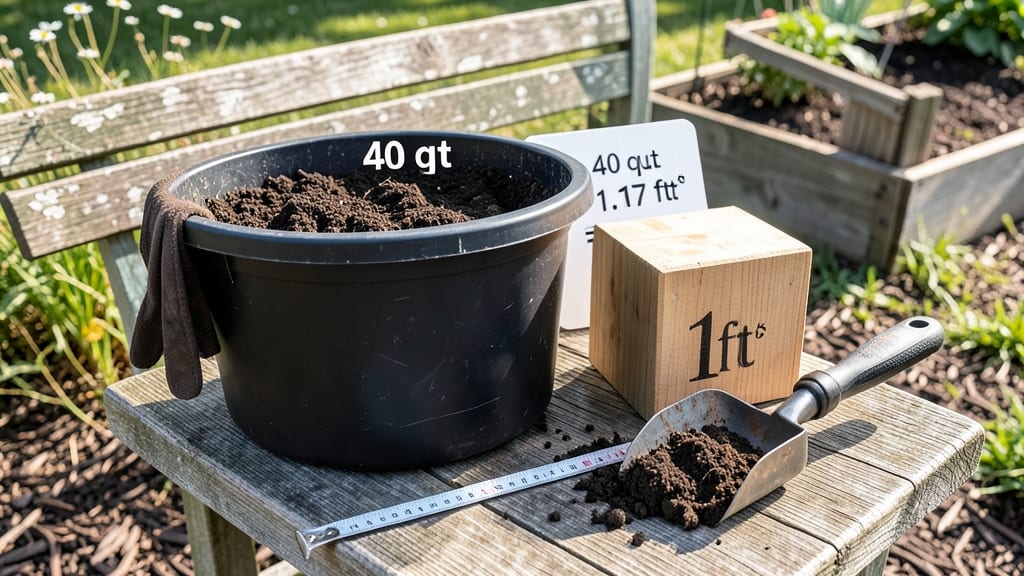
Converting 40 quarts of soil to cubic feet equals approximately 1.19 cubic feet by volume, though weight varies—dry potting mix typically weighs 55–65 pounds, while moist garden soil may reach 70–85 pounds depending on moisture and organic content.
Understanding this conversion helps gardeners plan projects efficiently. Since 1 cubic foot equals 25.33 quarts, the math is straightforward—but soil weight changes dramatically based on moisture and organic matter.
For example, sandy soil weighs less than loam or clay-heavy mixes, which can be 20% heavier when wet. 🌱 This explains why a 40-quart bag might feel lighter than expected if it's dry potting soil versus garden dirt.
Knowing these details saves money and space. A 1.19 cubic foot volume translates to about 10 standard 1-gallon pots (since 1 gallon ≈ 0.134 cubic feet), or roughly half a cubic yard (27 cubic feet).
For raised beds, this equals about 10 square feet at a 3-inch depth—perfect for small vegetable gardens or container setups.
💡 In This Article
- How Soil Volume Conversions Work in Gardening
- Practical Uses for 40-Quart Soil in Planting Projects
How soil volume conversions work in gardening
The conversion from quarts to cubic feet relies on a simple ratio: 1 cubic foot equals 25.33 quarts. This means 40 quarts of soil directly translates to 1.19 cubic feet—a figure derived from dividing 40 by 25.33.
However, this is purely a volume measurement, and soil's weight can vary dramatically based on its composition. For instance, sandy soil, which is less dense, might weigh only 45–55 pounds for 40 quarts, while clay-heavy soil could reach 75–85 pounds due to its compacted structure and higher mineral content.
The density of soil is influenced by its particle size and moisture content. Sandy soil has larger particles with air gaps, making it lighter, while clay soil has tiny particles that pack tightly, increasing weight.
Moisture adds another layer—wet soil can weigh 20–30% more than dry soil because water fills those air gaps. For example, a 40-quart bag of dry potting mix might weigh 55 pounds, but if saturated, it could swell to 70 pounds or more.
This variability is why gardeners often measure soil by volume rather than weight for consistency.
Understanding these conversions helps avoid overbuying or running out of soil mid-project. For example, if you're filling a 10-square-foot raised bed with 3 inches of soil, you'll need about 1.5 cubic feet—meaning you'd need roughly 38 quarts (or slightly more for clay-heavy soil).
This precision prevents waste and ensures your plants have the right growing medium. 🌱 The key is to account for both volume and weight, especially when dealing with heavy clay or moisture-rich soils.
Soil type also affects how it settles over time. Loamy soil, often considered ideal for gardening, strikes a balance—it retains moisture without becoming waterlogged and has a moderate weight of 60–70 pounds for 40 quarts.
Sandy soil drains quickly but may require more frequent watering, while clay soil holds nutrients well but can become compacted. Knowing your soil's characteristics helps you adjust planting depths and watering schedules accordingly.
For practical purposes, gardeners often use the 1 cubic foot ≈ 25 quarts rule of thumb. This simplifies calculations when planning projects like container gardening or raised beds. For instance, a 5-gallon bucket (≈0.67 cubic feet) would hold roughly 17 quarts of soil.
This quick conversion helps visualize how much soil you'll need for specific tasks without needing a calculator every time. 💫
One common mistake is assuming all soils behave the same way. For example, peat-based potting mixes are lightweight (often 40–50 pounds for 40 quarts) but compress significantly when wet, while garden soil from your yard may weigh more due to organic matter and minerals.
Always check the density of your specific soil type—this knowledge can save you time, money, and frustration during planting season.