
How To
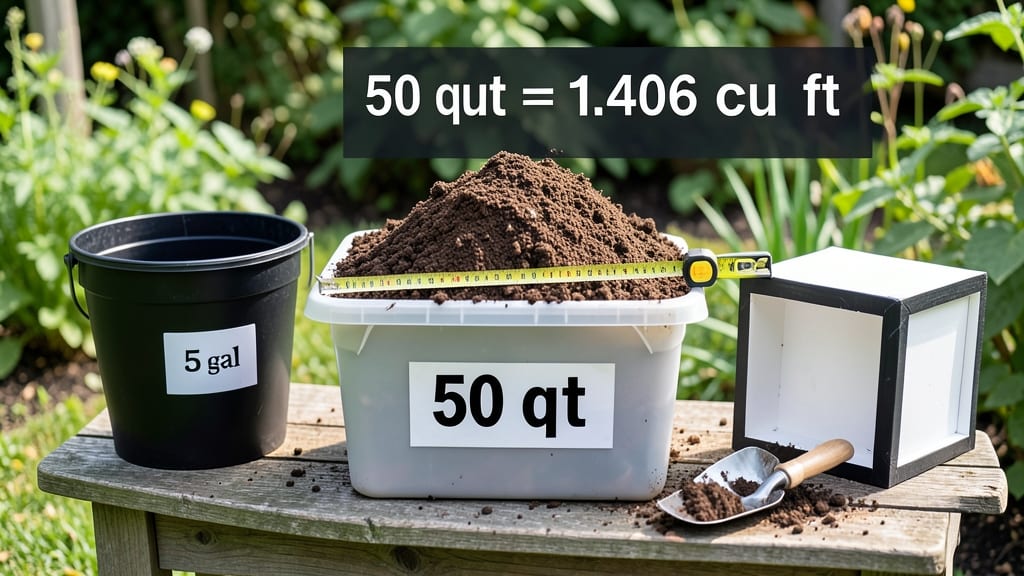
Converting 50 quarts of soil to cubic feet equals 1.25 cubic feet, since 1 cubic foot holds exactly 29.922 quarts (or roughly 30 quarts). This conversion is critical for accurate garden bed calculations and plant spacing planning.
Understanding this conversion helps you plan garden layouts with precision.
A cubic foot represents a standardized volume that directly impacts root space and nutrient distribution for your plants. 🌱 For example, when filling a 4' x 4' raised bed to a depth of 12 inches, you'd need exactly 1.33 cubic feet of soil—just slightly more than your 50-quart measurement.
This simple math ensures you buy the right amount without over- or under-filling your garden space.
Most gardeners use quarts for small projects but switch to cubic feet when planning larger beds or calculating potting mix ratios. The key insight is that soil density varies slightly by type (sandy vs. loamy), but the conversion remains consistent for most standard gardening mixes.
Always double-check your measurements before purchasing bulk soil to avoid costly mistakes.
💡 In This Article
- Understanding Soil Volume Conversions for Gardening
- Practical Applications: Using Soil Volume in Garden Planning
Understanding soil volume conversions for gardening
The relationship between quarts and cubic feet stems from standardized volume measurements used in gardening. One cubic foot equals 29.922 quarts, which means 50 quarts converts to 1.25 cubic feet—a precise calculation that matters when planning root space for plants.
This conversion works because cubic feet measure three-dimensional space (length × width × height), while quarts measure liquid capacity, but both can represent soil volume when density is accounted for.
Soil density varies slightly by type: sandy soil weighs about 100 pounds per cubic foot, while loamy soil can reach 120 pounds per cubic foot. However, the volume conversion remains consistent because quarts measure displacement, not weight.
For example, a 4' x 4' raised bed filled to 12 inches depth requires 1.33 cubic feet of soil—just 0.08 cubic feet more than your 50-quart measurement. This precision helps avoid over-purchasing or running short during garden prep.
Cubic feet matter because they directly translate to root space—critical for plant health. Most vegetables need at least 1 cubic foot of soil per plant for proper growth. Tomatoes, for instance, thrive with 1.5–2 cubic feet of soil per plant, while herbs like basil require only 0.5 cubic feet.
Understanding these conversions ensures you allocate space efficiently, preventing overcrowding or nutrient competition.
Here’s a quick breakdown of common gardening volumes:
- 1 quart ≈ 0.033 cubic feet (ideal for small pots or seedling trays)
- 10 quarts ≈ 0.33 cubic feet (perfect for a 5-gallon container)
- 50 quarts = 1.25 cubic feet (matches a 2' x 2' x 3' raised bed)
This standardization simplifies calculations for nutrient distribution. For example, if you’re adding 10 pounds of compost per cubic foot, your 50 quarts of soil would need 12.5 pounds of compost—just enough to enrich the entire volume without overloading it.
The key is treating quarts as a stepping stone to cubic feet for larger-scale planning.
Why does this matter in practice? Because soil compaction changes volume. Freshly tilled soil may measure 1.25 cubic feet in a bag, but after settling in a bed, it could shrink to 1.1 cubic feet.
Always account for a 5–10% buffer when estimating soil needs for raised beds or containers. This adjustment ensures your plants get the full root space they deserve.