
Advice
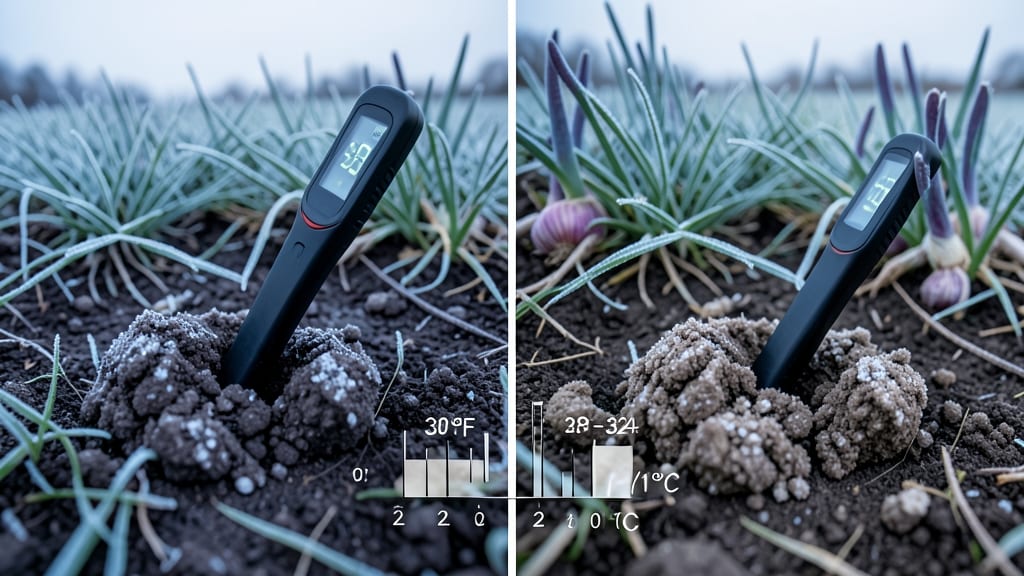
Soil freezes at 28–32°F (-2 to 0°C), with deeper layers reaching freezing temperatures (20–25°F/-6 to -4°C) based on moisture levels, organic material, and protective cover. Most plants suffer frost damage when soil temperatures drop to 28°F (-2°C) or below for prolonged periods.
Understanding these temperature thresholds helps gardeners prepare for frost. 🌡️ The topsoil freezes first because it loses heat faster to the cold air, while deeper layers retain warmth longer. Sandy soils freeze more quickly than clay because they drain water, which lowers their heat capacity.
I've seen mulch like straw or pine needles delay freezing by up to 2–4°F by trapping heat and insulating roots.
For plants, the real danger isn't just the cold soil but how long it stays frozen. A brief dip below 28°F might not harm hardy crops, but extended exposure can kill tender roots.
That's why I always check the 5-day forecast before planting frost-sensitive veggies—timing can mean the difference between a thriving garden and a frozen mess.
💡 In This Article
- Soil Freezing Temperature Science: How Climate and Composition Affect Freeze Points
- Protecting Plants from Frozen Soil: Mulching, Cold-Hardy Crops, and Timing Tips
Soil freezing temperature science: how climate and composition affect freeze points
The freezing process in soil isn't just about hitting a single temperature—it's a complex interplay of physics and chemistry. When air temperatures drop to 28–32°F (-2 to 0°C), the top 1–2 inches of soil begin freezing first because they lose heat directly to the cold atmosphere.
This is where phase change happens: water molecules in soil pores transition from liquid to ice, releasing latent heat that temporarily buffers the temperature drop. 🌡️ In sandy soils, this process occurs faster because sand has lower heat capacity and poorer water retention than clay.
Moisture content dramatically alters freeze thresholds. Wet soil freezes at 28–30°F (-2 to -1°C), while dry soil can drop to 20°F (-7°C) before freezing because water acts as a natural insulator.
Organic matter like compost also plays a role—it increases water retention and acts as a thermal buffer, delaying freeze penetration by 1–3°F.
That's why garden beds with rich compost often survive light frosts when nearby bare soil doesn't. The deeper you go, the slower the temperature drops: at 6 inches, you might see 25°F (-4°C), and at 12 inches, it could stay above freezing even when surface temps are 20°F (-7°C).
Heat conduction through soil follows predictable patterns, but real-world conditions create variations. Snow cover can insulate soil by 5–10°F, while wind-chill effects make exposed soil freeze faster.
I've noticed that in my zone 5b garden, a clear night with 25°F (-4°C) air temps can freeze topsoil to 2 inches, but the same conditions under 4 inches of snow might only freeze the top ½ inch.
This is why mulching with straw or leaves becomes critical—it mimics snow's insulating effect while being more practical for gardeners.
Soil type creates another layer of complexity. Clay soils freeze more slowly because their tiny particles trap water and heat, while sandy soils freeze quickly due to their loose structure.
The specific heat capacity of water (1 calorie per gram per °C) means moist soils resist temperature changes better than dry ones. This is why gardeners in USDA zone 6 often see 2–3°F differences in freeze depth between clay and sandy plots during the same frost event.
Understanding these variations helps explain why some plants thrive while others fail in the same garden.
Here's what most gardeners overlook: frost penetration speed. While surface soil might freeze at 30°F (-1°C), deeper layers take hours to days to reach freezing. This delayed response is why root crops like carrots can survive light frosts—their roots stay warm longer.
The same principle explains why mulch depth matters: a 3-inch layer of straw can delay freeze penetration by 1–2 weeks in early fall, giving tender plants a fighting chance. 🌱 This delayed freezing also affects soil microbes, which become less active below 32°F (0°C), slowing decomposition and nutrient cycling.
For precise planning, consider these key factors when assessing freeze risks:
- Soil moisture: Wet soil freezes at 28–30°F (-2 to -1°C); dry soil at 20°F (-7°C)
- Organic matter: Adds 1–3°F of insulation to freeze points
- Depth: 6-inch depth freezes 5–10°F slower than surface
- Mulch/snow: Can delay freezing by 2–4°F or 1–2 weeks