
Container Gardens
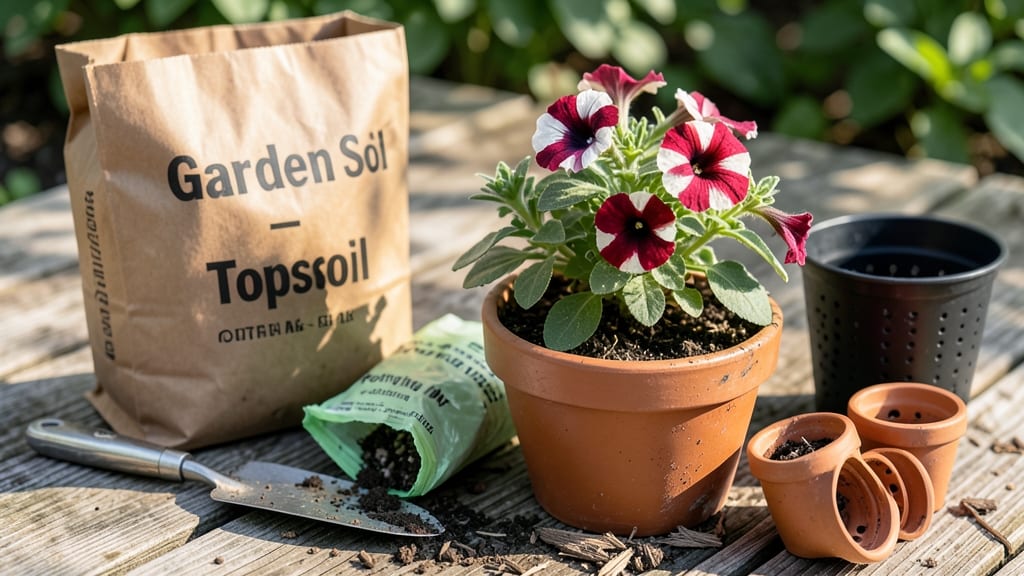
You shouldn't use garden soil in containers because it compacts easily, drains poorly, and may harbor pests or diseases. Instead, opt for lightweight potting mixes with perlite, vermiculite, or coconut coir for better aeration and drainage.
Garden soil is designed for in-ground planting where roots can spread freely, but containers create a confined space that causes soil to break down faster. 🌱 The dense particles in garden soil trap moisture, leading to root rot, while the lack of organic matter means nutrients deplete quickly.
For container plants, the right mix should include ingredients that improve both drainage and airflow—like perlite or coconut coir—to keep roots healthy and prevent waterlogging.
Many gardeners make the mistake of mixing garden soil with compost, thinking it improves the blend.
However, this still creates a heavy, compacted medium that struggles to support container plants. 🌿 The ideal potting mix should be fluffy, well-draining, and rich in organic material to mimic natural soil conditions while adapting to the limited space of pots.
Always check the label for "potting mix" rather than "garden soil" to ensure you're using the right product.
💡 In This Article
- Why Garden Soil Fails in Container Gardening
- Best Potting Soil Mixes for Container Plants
Why garden soil fails in container gardening
Garden soil is engineered for in-ground planting where roots can expand freely, but containers create a confined environment that exposes its flaws. The dense mineral particles in garden soil—like clay and sand—lack the air pockets needed for root respiration, leading to compaction.
When you pack this heavy soil into a pot, it compresses under the weight of plants and water, reducing oxygen flow to roots by up to 70% compared to loose potting mixes. This suffocation causes roots to suffocate, stunting growth or triggering rot.
The drainage issue is even more critical. Garden soil typically holds 30-40% water by volume, but in containers, this water has nowhere to escape quickly.
Without proper drainage holes, excess moisture sits at the bottom, creating anaerobic conditions that promote harmful bacteria and fungi. 🌧️ For example, a 10-inch pot filled with garden soil may take 3-5 days to dry out completely, while a comparable potting mix with perlite drains in just 1-2 days.
This prolonged moisture also leaches nutrients faster, leaving plants nutrient-starved within weeks.
Pests and diseases thrive in garden soil because it often contains weed seeds, larvae, and pathogens from the ground. Containers concentrate these problems—imagine a single aphid infestation spreading unchecked in a small pot versus a larger garden bed.
The lack of beneficial microbes in garden soil further weakens plant defenses. Even sterilized garden soil can't replicate the balanced ecosystem of a quality potting mix, which includes mycorrhizal fungi and beneficial bacteria to support root health.
Nutrient imbalances are another hidden danger. Garden soil's organic matter decomposes unevenly in containers, creating hotspots where nutrients spike or disappear entirely.
For instance, nitrogen-rich compost added to garden soil may cause rapid leaf growth while starving roots of phosphorus. 🌱 In contrast, potting mixes are formulated with slow-release fertilizers and balanced amendments to provide steady nutrition.
This inconsistency forces container plants to work harder, often resulting in yellowing leaves or stunted blooms despite regular feeding.
Consider the texture difference: garden soil feels gritty and dense when moist, while ideal potting soil has a light, crumbly structure. This isn't just about feel—it's about root penetration. In containers, roots need to explore every inch of soil for stability, but compacted garden soil resists this growth pattern.
Even heavy feeders like tomatoes or peppers struggle in garden soil because their roots can't access sufficient oxygen or water efficiently.
For visual comparison, imagine pouring water into two identical pots—one with garden soil and one with potting mix. The garden soil version will form a hard crust on top while staying soggy below, while the potting mix allows water to distribute evenly and drain freely.
This simple test demonstrates why professional growers avoid garden soil in containers entirely.