
Neem Oil
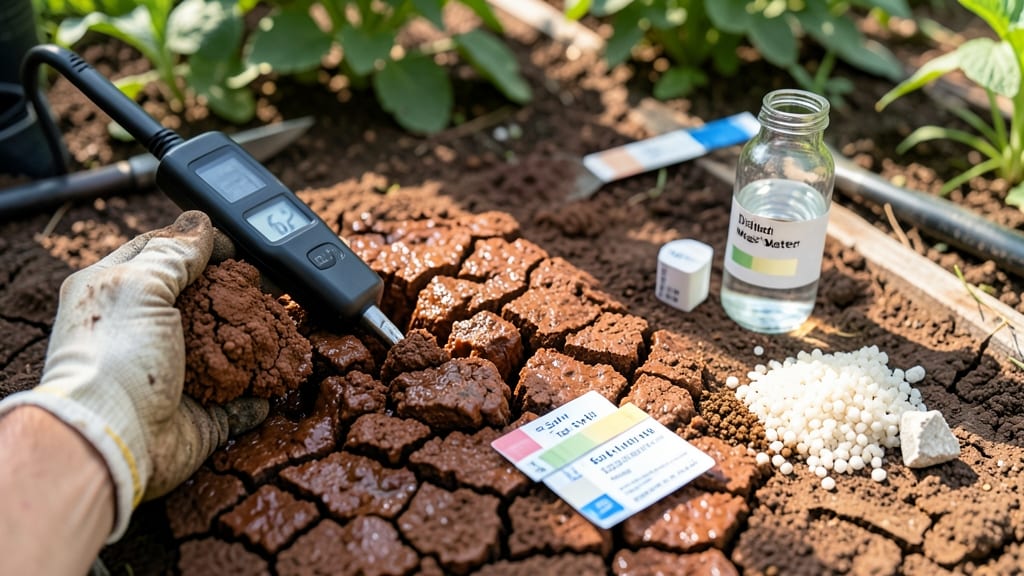
The clay soil pH level usually falls between 5.5 and 7.5, but its dense nature often holds onto acidity longer than lighter soils. Since most plants prefer a slightly acidic to neutral range (6.0–7.0), you may need to add lime or sulfur to balance nutrient access for healthy root development.
The reason clay soil behaves this way comes down to its high cation exchange capacity (CEC), which means it holds onto nutrients—and acidity—more tightly than sandy or loamy soils. 🌱 This trapped acidity can lock out essential nutrients like phosphorus and calcium while making iron less available, even if the pH reads within the "safe" range.
For example, blueberries thrive in acidic clay (pH 4.5–5.5), but tomatoes and peppers need that neutral 6.0–7.0 range to access the nutrients they crave.
To adjust clay soil pH, start by testing it with a home kit or lab analysis—clay's compacted nature can skew results if you don't account for its density.
Organic amendments like wood ash (to raise pH) or elemental sulfur (to lower it) work well, but you'll need to apply them more heavily than in loamy soil.
Spread amendments in early spring or fall, water thoroughly, and retest in 2–3 months since clay takes longer to break down and integrate changes.
💡 In This Article
- How Clay Soil pH Impacts Nutrient Availability
- Step-by-Step pH Adjustment for Heavy Clay Gardens
How clay soil pH impacts nutrient availability
Clay soil's high cation exchange capacity (CEC)—typically ranging from 10-30 meq/100g—means it holds onto positively charged ions (like hydrogen, aluminum, and calcium) far more tightly than sandy or loamy soils.
This dense structure creates microscopic pores that trap acidity, often making clay soil appear more acidic than its actual pH reading suggests. For example, a clay soil with a measured pH of 6.0 might behave like a pH 5.5 environment for plants due to these trapped acidic ions.
The compacted nature of clay soil also slows water drainage, which accelerates organic matter decomposition and releases more hydrogen ions over time.
This ongoing acidification process explains why clay gardens often require more frequent pH adjustments than loamy or sandy soils. 🌱 Nutrient availability becomes a balancing act: phosphorus becomes locked in at pH <5.5, while calcium and magnesium leach out when pH exceeds 7.5.
Iron, a micronutrient crucial for chlorophyll production, becomes increasingly unavailable as pH rises above 6.5.
Consider blueberries, which thrive in clay soil's naturally acidic environment (pH 4.5–5.5). Their root systems can access iron and manganese efficiently, but the same soil would starve tomatoes of phosphorus if not amended. The key difference lies in how clay soil's CEC interacts with plant-specific nutrient requirements.
For instance, while lime raises pH by neutralizing acidity, it also increases calcium availability—critical for cell wall development in vegetables like cabbage and broccoli.
This nutrient lockout phenomenon isn't just theoretical. In field studies, clay soils with pH 6.0 showed 30% lower phosphorus uptake in corn plants compared to identical soils with pH 6.5, despite both falling within the "ideal" range.
The reason? Clay's microscopic structure creates localized pH variations where nutrients become temporarily inaccessible to roots. This explains why even "balanced" pH readings can lead to stunted growth if the soil's physical properties aren't considered.
For gardeners, this means pH testing should go beyond surface measurements. Digging 2-3 inches deep often reveals significant pH variations between the topsoil and subsoil layers in clay gardens. The dense clay layer below typically holds more acidity, creating a nutrient gradient that affects root development.
Understanding this vertical pH profile helps explain why some plants thrive while others struggle, even when surface pH appears optimal.
The solution lies in targeted amendments that account for clay's unique behavior. Unlike sandy soils where changes occur quickly, clay requires 3-6 months for amendments to fully integrate due to its slow water movement and microbial activity.
This delayed response means timing adjustments for spring planting cycles becomes particularly critical in clay-heavy regions.