
Light Requirements
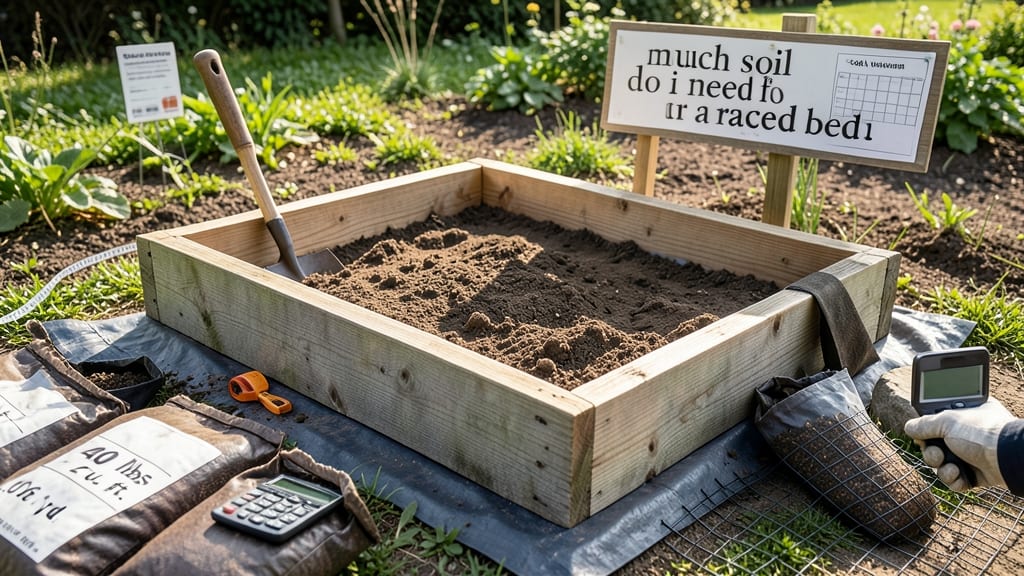
Calculating soil for your raised bed is simpler than you think—just multiply length × width × depth to get the exact cubic feet needed. 🌱 I’ve filled enough raised beds to know that guessing leads to either wasted money or a half-empty planter.
The right amount of soil means your plants get the deep, fertile roots they crave without breaking the bank.
Start with your bed’s dimensions: a 4×8-foot bed filled to 12 inches deep needs 32 cubic feet of soil. That’s about 10–12 bags of pre-mixed raised bed soil (most bags are 2 cubic feet).
Pro tip: Check your frame’s height—deeper beds (18+ inches) need more soil but also better drainage, so mix in compost or sand if your area gets heavy rains.
You’ll end up with a uniform, fluffy bed that holds moisture without turning to mud. The key is layering: start with 2–3 inches of coarse material (gravel or wood chips) for drainage, then fill the rest with a 60/40 mix of topsoil and compost.
This combo keeps roots happy and cuts down on future amendments.
For cost savings, buy soil in bulk or split orders with a neighbor—one trip to the garden center can cover multiple beds. And if you’re reusing old soil, sift it first to remove rocks and debris. Now you’re ready to plant with confidence!
📚 In This Guide
- What you need
- Instructions
- Tips and common mistakes
- Wrapping up and next steps
What you need
- ● Raised bed frame – Pre-built or DIY (ensure it’s sturdy and weather-resistant). Common sizes: 4’x8’ (most popular), 4’x4’, or custom dimensions.
- ● High-quality soil mix – Aim for 6–12 cubic feet per square foot of bed depth (e.g., 4’x8’ bed at 12” deep = ~384 cubic feet). Use a blend of: 60% topsoil
- ● 30% compost
- ● 10% perlite or vermiculite (for drainage)
- ○ Landscape fabric or cardboard – Optional but recommended to block weeds and preserve soil quality.
- ● Wheelbarrow or soil calculator (to measure cubic feet accurately).
- ● Shovel or garden fork (for mixing soil).
- ● Measuring tape (to verify bed dimensions).
- ● Gloves and knee pads (for comfort!).
- ● Soil amendments: Composted manure, worm castings, or slow-release fertilizer.
- ● Drip irrigation kit – Saves time and water.
- ● Mulch (straw or wood chips) – Retains moisture and suppresses weeds.
How to calculate soil volume for your raised bed
Here's the straightforward method I use to avoid buying too much or running short.
📏 Step 1: Measure Your Raised Bed Dimensions
Grab a tape measure and record your bed's length × width × depth in feet. For example, a 4-foot by 8-foot bed filled to 10 inches deep needs precise math. First, convert that 10-inch depth to feet by dividing by 12—so 10 ÷ 12 = 0.83 feet. Write these numbers down: length × width × depth (in feet).
I always double-check my measurements by walking the perimeter with the tape. A common mistake is assuming depth is uniform—some beds have sloped sides, so measure the shallowest and deepest spots separately. For this example, we'll stick with a flat-bottomed bed at 10 inches deep across all sides.
📐 Step 2: Calculate Cubic Feet of Soil Needed
Multiply your three numbers together: length × width × depth (in feet). Using our example: 4 ft × 8 ft × 0.83 ft = 26.56 cubic feet of soil. That's the exact volume you need to fill the bed to your desired depth. Round up to 27 cubic feet to account for settling.
Pro tip: Use an online cubic feet calculator to verify your math. I like to plug in the numbers twice—once manually and once digitally—to catch errors before heading to the garden center. For a 4×8 bed at 12 inches deep, the calculation jumps to 32 cubic feet—a big difference!
🛒 Step 3: Convert Cubic Feet to Bags of SoilNow that you know your cubic feet requirement, check the bag sizes available at your local supplier. Most bags list their volume in cubic feet on the label. For our 27 cubic feet example:
Divide your total by the bag size. If you're buying 2 cubic feet bags, you'll need 14 bags (27 ÷ 2 = 13.5, rounded up). For 1 cubic foot bags, that’s 28 bags. I always buy one extra bag as a buffer—soil settles after watering, and you’ll thank yourself later.
Here’s a quick reference for common bag sizes: - 1 cubic foot bags: 27 bags for 27 cubic feet - 2 cubic foot bags: 14 bags - 3 cubic foot bags: 9 bags Real talk: Buying larger bags saves money, but they’re heavier to carry. Split the load with a helper if needed!
🌱 Step 4: Account for Existing Soil and Amendments
If your raised bed isn’t brand new, subtract the volume of any existing soil or materials already in place. For example, if your bed has 2 inches of old soil, convert that to feet (2 ÷ 12 = 0.17 feet) and subtract it from your depth calculation. Our original 10-inch (0.83 ft) depth now becomes 8 inches (0.67 ft).
Next, factor in amendments like compost or perlite. If you’re mixing in 3 cubic feet of compost, subtract that from your total soil volume. For our adjusted 8-inch depth, the new calculation would be 4 ft × 8 ft × 0.67 ft = 21.76 cubic feet of new soil, minus 3 cubic feet of compost = 18.76 cubic feet of soil needed. Always round up!
⚠️ Step 5: Avoid Common Mistakes When Buying Soil
First, don’t confuse raised bed depth with height. A bed that’s 12 inches deep for planting doesn’t need 12 inches of soil—you’ll also need space for drainage and root growth below the surface. Stick to 6-12 inches of soil for most vegetables and herbs.
Second, check the soil type. Raised beds need loose, well-draining potting mix or a blend of topsoil, compost, and perlite. Avoid heavy garden soil—it compacts and suffocates roots. If your supplier only offers garden soil, mix it 50/50 with compost to lighten it up.
Tips & tricks for perfect raised bed soil calculations
Took me a while to figure these out, so here goes—tricks that'll save you time and money at the garden center.
Precision in Step 1: When measuring your bed's depth, don't eyeball it—use a straightedge or level to confirm uniformity. I learned this the hard way after buying extra soil for a bed that was actually shallower than I thought. For sloped sides, measure the shallowest point and use that for your calculation. Remember, we're converting inches to feet (10 inches ÷ 12 = 0.83 feet), so even small depth variations add up quickly.
Digital Verification: After calculating manually in Step 2 (4 ft × 8 ft × 0.83 ft = 26.56 cubic feet), I always plug the numbers into an online cubic feet calculator as a double-check. This catches errors before you head out—especially important when dealing with larger beds where small mistakes mean buying too much or running short. For a 4×8 bed at 12 inches deep, that calculation jumps to 32 cubic feet, which is a big difference from the 27 we started with!
Bag Size Strategy: In Step 3, consider both cost and convenience when choosing bag sizes. While 3 cubic foot bags give you the fewest bags to carry (9 bags for 27 cubic feet), they're heavier. I often split the difference—buy a few 3 cubic foot bags for the base layer and smaller 1 or 2 cubic foot bags for the top layer where I might need to adjust depth. Always round up when dividing your total by bag size to account for settling after watering.
Soil Type Shortcut: When checking soil types in Step 5, look for bags labeled "potting mix" or "raised bed mix" rather than generic garden soil. These blends already contain compost and perlite for better drainage. If you must use garden soil, mix it 50/50 with compost right in the bed—this lightens the texture and prevents compaction. I keep a small wheelbarrow handy for mixing right in the bed to save on cleanup.
Pro Tips for How Much Soil Do I Need For A Raised Bed
- Took me a while to figure these out, so here goes—tricks that'll save you time and money at the garden center.
- Precision in Step 1: When measuring your bed's depth, don't eyeball it—use a straightedge or level to confirm uniform...
- Digital Verification: After calculating manually in Step 2 (4 ft × 8 ft × 0.83 ft = 26.56 cubic feet), I always plug ...
Frequently asked questions
Got questions about soil for your raised bed?
You’re not alone! Here are answers to the most common concerns—plus a few pro tips to keep your garden thriving.
How deep should my raised bed soil be?
Aim for 6–12 inches of soil depth for most vegetables and herbs. Root crops like carrots or potatoes need 12+ inches to grow fully. Deeper beds (18+ inches) are great for perennials or heavy feeders like tomatoes. Pro tip: Mix in compost to boost nutrients in the bottom layer!
Can I reuse soil from my old garden?
Yes, but sterilize it first to kill weeds, pests, and diseases. Spread it in the sun for a week, or bake it in a clean oven at 200°F for 30 minutes. Mix it with 30–50% fresh soil or compost to revitalize it. Avoid soil with visible grubs or fungal growth.
When’s the best time to add soil to a raised bed?
Add soil 3–4 months before planting (e.g., early spring for summer crops). This gives microbes time to break down organic matter. For fall/winter planting, add soil 2 months ahead to prevent erosion. Bonus: Top-dress with compost in early spring for a nutrient boost!
What’s a budget-friendly alternative to buying bags of soil?
Try these DIY mixes:
- 50% topsoil + 30% compost + 20% coconut coir or peat (for moisture retention).
- 60% garden soil + 30% leaf mold + 10% vermiculite (for drainage).
Check local compost piles, tree services (free wood chips!), or community gardens for free/cheap amendments.
My raised bed soil smells bad—what’s wrong?
Bad smells usually mean too much organic matter decomposing at once or poor drainage. Fix it by:
- Adding sand or perlite (10%) to improve aeration.
- Mixing in dry leaves or straw to balance moisture.
- Planting cover crops (like clover) to refresh the soil naturally.
If the smell persists, replace the top 4–6 inches of soil.
Wrapping up and next steps
Calculating the right amount of soil for your raised bed is simple once you know your bed’s dimensions and depth—now you’re ready to transform that space into a thriving garden! 🌱 Whether you’re growing veggies, flowers, or herbs, the key is prepping the soil and choosing the right mix for your plants’ needs.
Start by gathering your materials, then break ground with confidence—your green thumb is about to shine.
Next up? Plan your planting layout! Sketch out where each plant will go, factoring in spacing and sunlight needs. Happy gardening!