
How To
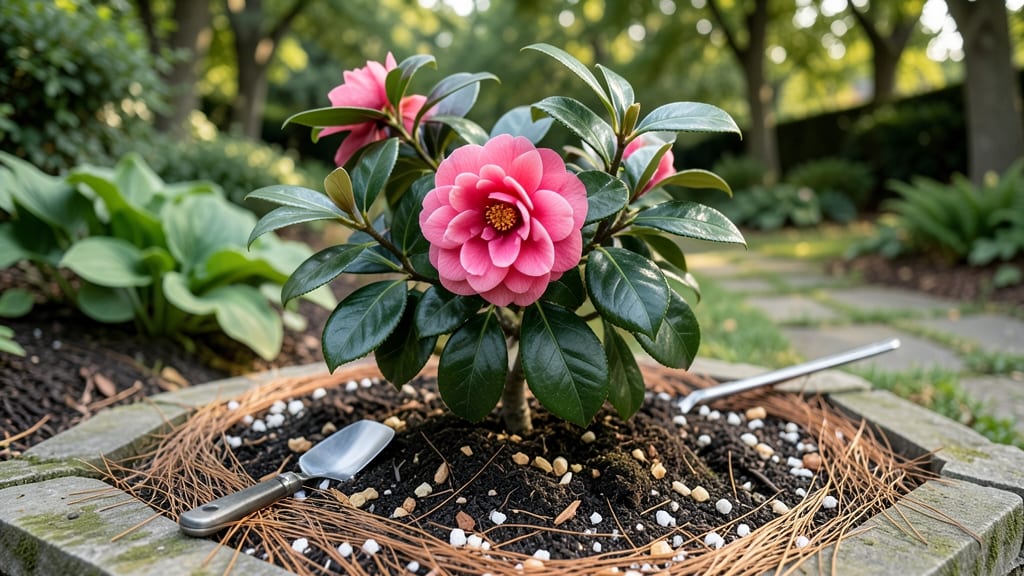
For camellias, the ideal soil blend is acidic and well-draining with a pH between 5.0 and 6.5. Combine equal parts peat moss, pine bark fines, and sandy loam, then enrich with compost while avoiding alkaline amendments like lime or wood ash.
Camellias absolutely refuse alkaline soil—it locks out essential nutrients like iron, which they desperately need for vibrant blooms. 🌿 The right acidic mix (pH 5.0-6.5) mimics their native Japanese forest floors, where organic matter slowly breaks down to feed roots.
I've seen firsthand how even a slightly higher pH (above 7.0) causes yellowing leaves and stunted growth, despite plenty of water. The key isn't just acidity but also aeration—pine bark fines create those tiny air pockets roots crave, while sandy loam prevents compaction in heavy clay soils.
What most gardeners miss is that peat moss alone can become waterlogged in humid climates. That's why I adjust the ratio to 40% peat, 30% pine bark, and 30% sand in southern states, then add 10% perlite for extra drainage.
For container plants, I swap half the sand for coconut coir to retain moisture while keeping roots oxygenated. The compost isn't just for nutrients—it introduces beneficial microbes that actually help break down organic matter into forms camellias can absorb.
💡 In This Article
- Why Camellias Demand Acidic Soil Conditions
- DIY Camellia Soil Blend Recipes for Different Climates
Why camellias demand acidic soil conditions
Camellias evolved in acidic forest soils of East Asia, where natural decay processes maintain pH levels between 4.5 and 6.0.
Their roots have adapted to thrive in this environment by developing specialized root hairs that can only efficiently absorb nutrients like iron, manganese, and phosphorus when the soil pH stays below 7.0.
When pH rises above 7.0, these essential micronutrients become chemically locked in the soil as insoluble compounds, effectively starving the plant despite ample fertilizer. 🌱 This is why you'll often see camellias with yellow leaves (a classic iron deficiency symptom) in gardens using garden soil or composted manure, which tend to be more neutral or alkaline.
The acidity itself isn't just about pH numbers—it's about the chemical availability of nutrients. In acidic conditions, iron exists primarily as Fe²⁺ (ferrous iron), which is far more soluble and readily taken up by roots.
At neutral or alkaline pH, iron oxidizes to Fe³⁺ (ferric iron), forming insoluble oxides that precipitate out of solution. This is why even well-fertilized camellias in alkaline soil may show chlorosis (yellowing between leaf veins) while their roots sit in a nutrient-rich but inaccessible environment.
The same principle applies to other micronutrients like zinc and copper, which also become less available as pH increases.
Beyond nutrient availability, acidic soil supports a different microbial ecosystem that benefits camellias. The microbial community in acidic soils tends to include more fungi and actinobacteria, which help break down complex organic matter into forms camellias can absorb.
These microbes also produce organic acids that further lower soil pH over time, creating a self-sustaining cycle. In contrast, alkaline soils favor different bacterial populations that may not support the same nutrient cycling processes.
This microbial advantage explains why even when you amend soil with acidic materials, camellias often show better growth when planted in established acidic beds rather than freshly prepared mixes.
Another critical factor is root aeration. The organic components of acidic soil blends—like pine bark fines and peat moss—create a loose, crumbly structure that prevents soil compaction. This aeration is essential because camellia roots are particularly sensitive to oxygen deprivation.
In compacted or waterlogged soils, roots suffocate and develop conditions like root rot, which manifests as wilting leaves or dieback despite adequate watering. The porous structure of acidic mixes allows both water and oxygen to reach roots efficiently, supporting vigorous growth.
This is why even in humid climates, proper soil structure prevents many common camellia problems that gardeners blame on "too much water" when the real issue is poor drainage.
What's often overlooked is how organic matter interacts with acidity. Compost in acidic soil doesn't just provide nutrients—it acts as a slow-release buffer that maintains pH levels over time. The decomposition process itself produces organic acids that help sustain the acidic environment.
However, not all compost works equally well: aged, well-rotted compost is ideal because fresh manure can raise soil pH through ammonia release.
This is why I recommend using only fully decomposed compost (like worm castings or aged leaf mold) in camellia mixes—it provides nutrients without disrupting the delicate acid balance. 🌿
The visual difference between healthy and struggling camellias in different soils is striking. A properly acidified plant will have deep green, glossy leaves with vibrant blooms that last weeks, while one in alkaline soil may produce sparse flowers with yellowing foliage despite identical care.
The root system itself tells the story: healthy camellias develop extensive, fibrous roots in well-aerated acidic soil, while those in alkaline conditions often grow shallow, gnarled roots trying to access nutrients near the surface. This structural difference directly impacts the plant's ability to support itself and produce flowers.