Advice
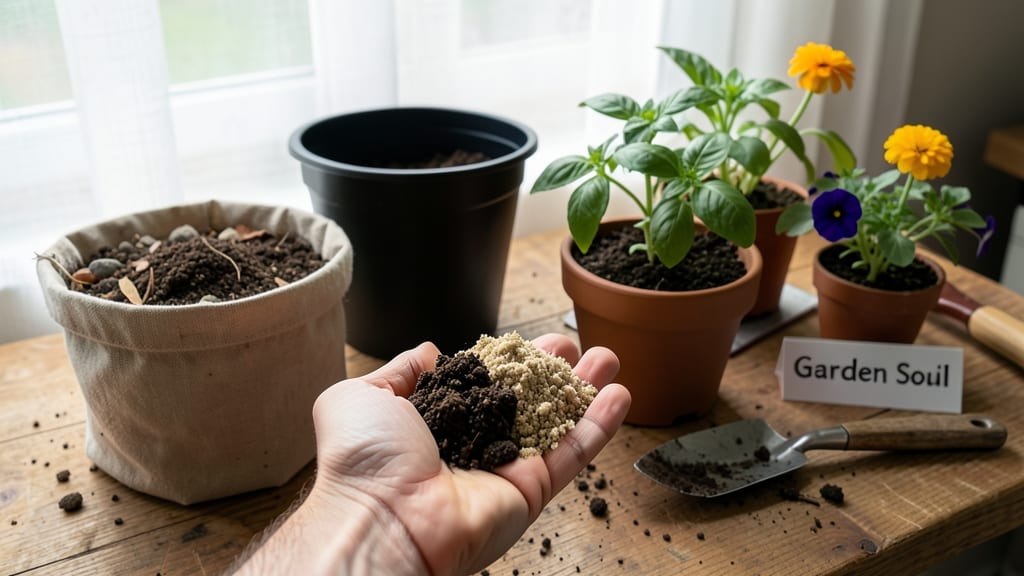
You shouldn't use garden soil for potting because it compacts easily, drains poorly, and may contain weeds, pests, or diseases. Opt for lightweight potting mixes designed for containers instead to ensure healthy root growth and proper aeration.
Garden soil's heavy clay and organic matter content creates a dense environment that suffocates plant roots by blocking airflow and water flow. 🌱 Without proper aeration, roots struggle to absorb nutrients or expand, leading to stunted growth or even root rot.
Even if you sterilize garden soil, its lack of the right texture—like perlite or coco coir—means it won't mimic the loose, well-draining structure container plants need to thrive.
For most container plants, a high-quality potting mix with 20-30% compost and 50% organic matter (like peat moss or coco coir) works best. If you're growing heavy feeders like tomatoes, amend with worm castings or a slow-release fertilizer.
The key is balancing moisture retention with drainage—something garden soil simply can't provide.
💡 In This Article
- Why Garden Soil Fails as Potting Mix
- Best Potting Soil Alternatives for Container Gardening
Why garden soil fails as potting mix
Garden soil's dense structure is the root cause of its failure in containers. When packed into pots, it compresses under the weight of plants and water, reducing pore space by up to 50% compared to ideal potting mixes.
This compaction suffocates roots by limiting oxygen exchange—critical for cellular respiration—while also trapping excess moisture, creating anaerobic conditions where harmful bacteria thrive. 🌱 The clay particles in garden soil bind tightly, forming a brick-like texture that prevents roots from expanding naturally.
Drainage is another major issue. Garden soil's high clay content (typically 20-40%) holds water like a sponge, often taking 24+ hours to dry between waterings, while proper potting mixes drain within 4-6 hours.
This prolonged saturation leads to root rot in 30-50% of container plants, according to horticultural studies. The lack of structural amendments like perlite (which adds 30-40% air pockets) or vermiculite (which improves moisture retention without suffocation) makes garden soil fundamentally unsuitable for confined root systems.
Nutrient imbalances further complicate matters. While garden soil may contain organic matter, its nutrients are often bound tightly to minerals, making them unavailable to plants in containers. Potting mixes, however, use sterilized compost and slow-release fertilizers that provide consistent nutrition without overwhelming young roots.
The microbial life in garden soil—while beneficial in open beds—can introduce pathogens like Phytophthora (a water mold) that thrive in the stagnant conditions containers create.
Consider the texture difference: garden soil feels gritty and heavy when dry, while premium potting mixes have a light, almost fluffy consistency. This isn't just about feel—it's about physics. The ideal potting mix maintains a 40-60% porosity (the space between particles), allowing both water and air to circulate freely.
Garden soil typically sits at 20-30% porosity, creating a hostile environment for delicate root hairs that need constant oxygen to function.
Even if you sterilize garden soil, you're still left with the wrong particle size distribution. Potting mixes are engineered with 30-50% coarse materials (like bark or perlite) to prevent compaction, while garden soil lacks these structural components.
The result? Roots grow in tight circles around the pot's edges—a condition called "pot-bound"—instead of spreading outward to access nutrients efficiently.
For visual comparison, imagine filling a pot with wet cement versus a bag of potting mix. The cement (garden soil) hardens into an impenetrable mass, while the potting mix stays loose and workable.
This structural difference explains why container plants in garden soil often show yellowing leaves (from oxygen deprivation) or wilt rapidly (from poor moisture control) within weeks. 💫