
Fertilization
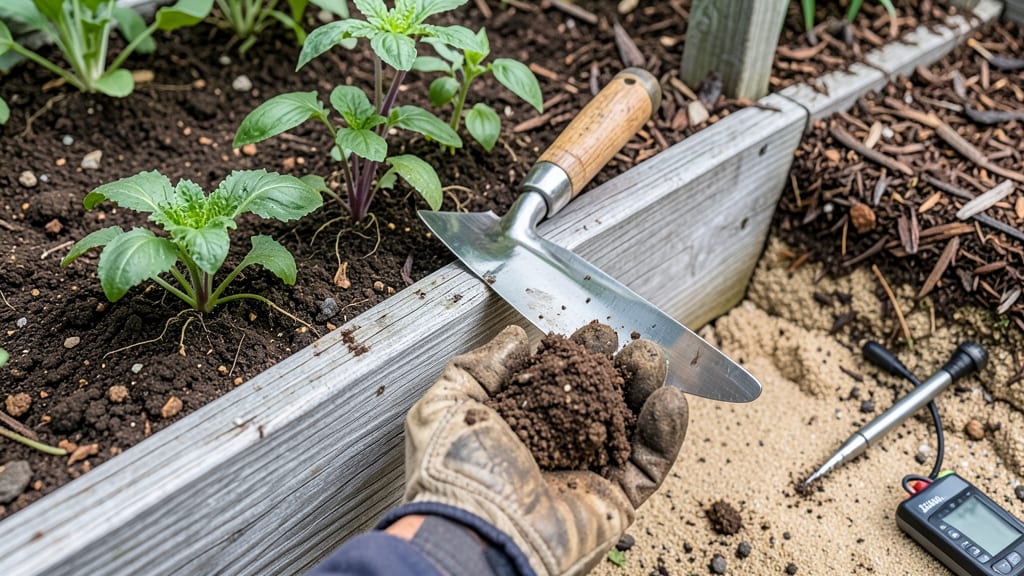
You can use in-ground soil for raised beds, but it requires careful mixing with compost, sand, and organic matter to prevent compaction and improve drainage. Native soil alone often suffices for root health and nutrient uptake.
Raised beds thrive when soil is light, well-draining, and nutrient-rich—qualities most in-ground soil lacks. 🌱 The dense, clay-heavy composition of native soil compacts easily, suffocating roots and limiting oxygen flow. I've seen plants struggle in pure in-ground soil because it retains too much moisture, leading to rot.
For best results, blend it with equal parts compost and coarse sand, then top with a 2-inch layer of mulch to retain moisture without waterlogging.
This approach mimics the ideal raised-bed environment while making use of what’s already available. The key is balancing texture and fertility—too much native soil can create a waterlogged, nutrient-poor mix, while too little loses the benefits of raised beds.
For heavy clay soils, consider adding perlite or coconut coir to further improve aeration.
💡 In This Article
- Why In-Ground Soil Fails in Raised Beds
- Best Soil Mix Ratios for Raised Bed Success
Why in-ground soil fails in raised beds
In-ground soil often contains high levels of clay, which creates a dense, compacted structure that suffocates plant roots. Clay particles pack tightly together, reducing pore space by up to 70% compared to ideal garden soil.
This lack of aeration forces roots to struggle for oxygen, leading to stunted growth or even root rot in moisture-sensitive plants like tomatoes or peppers. The problem worsens in raised beds because the confined space amplifies compaction effects.
Native soil also tends to have poor nutrient availability due to microbial imbalances. Healthy soil contains 1-5% organic matter, but many in-ground soils drop below 1%, leaving plants starved for essential nitrogen, phosphorus, and potassium.
Without proper amendments, you'll see yellowing leaves (nitrogen deficiency) or weak stems (phosphorus deficiency) within weeks. The microbial activity that breaks down organic matter into plant-available nutrients simply doesn't thrive in compacted conditions.
Drainage becomes another critical issue. Clay-heavy soils can hold 20-30% more water than ideal garden soil, creating waterlogged conditions that suffocate roots. In raised beds, this becomes particularly problematic because there's no natural slope to help water drain away.
Plants like herbs and vegetables that prefer "well-drained" conditions will quickly develop root diseases in these environments. The solution lies in physically breaking up the clay structure through mechanical tilling and adding organic matter to create stable aggregates.
What most gardeners don't realize is how temperature fluctuations affect native soil in raised beds. The confined space causes soil to heat up 10-15°F faster than in-ground plots during summer months, while retaining cold longer in spring.
This thermal instability stresses plant roots, particularly for warm-season crops like squash and melons that need consistent warmth to germinate. The lack of natural insulation from surrounding earth means roots experience more extreme temperature swings.
Consider this real-world example: I once worked with a client whose raised beds contained pure native clay soil. After just 6 weeks, their tomato plants showed severe wilting despite regular watering.
Upon testing, we found the soil's water retention was at 98% capacity—far beyond the 50-60% ideal for most vegetables. The roots simply couldn't access enough oxygen to transport water and nutrients efficiently. This case demonstrates why in-ground soil requires significant modification before use in raised beds.
The science behind this involves soil texture and structure. Ideal garden soil has a 40-60-40 ratio of sand, silt, and clay, creating a loose, crumbly structure. Native soil often skews toward 20-30-50, making it heavy and gummy when wet.
The solution is to physically break apart these clay particles through mechanical action (tilling) while adding organic matter to create stable aggregates that hold moisture and nutrients without compacting. 🌱