
Planting
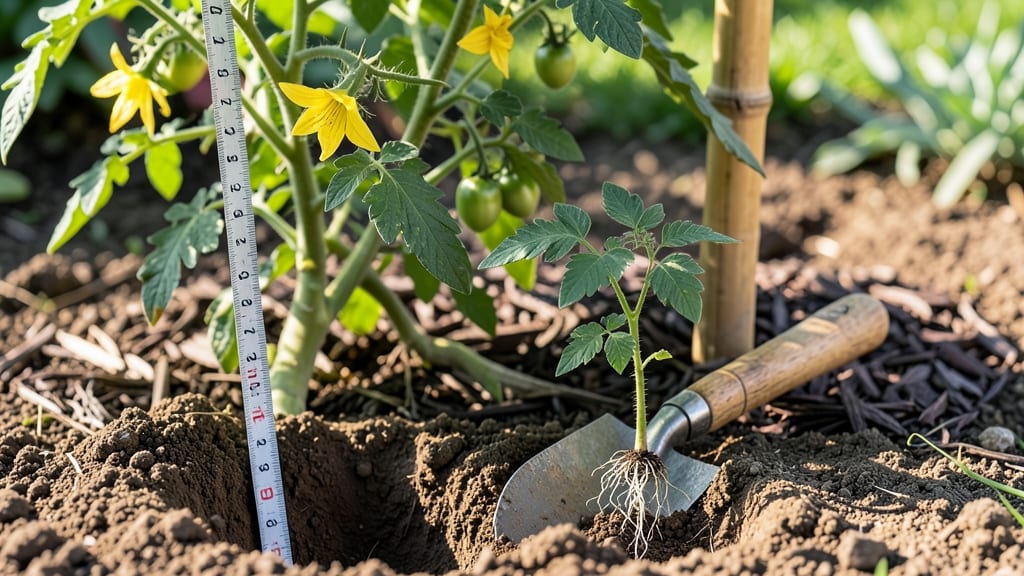
To grow healthy tomatoes, your soil should be at least 12–18 inches deep to accommodate their root systems, with larger varieties like beefsteaks thriving in 24+ inches. Loosen the top 6–8 inches before planting to encourage root growth and improve drainage.
Tomatoes develop extensive root systems that need ample soil space to absorb water and nutrients efficiently. 🌱 The deeper the soil, the better the roots can spread, especially for indeterminate varieties that grow continuously.
I’ve found that amending the soil with compost not only improves depth but also enhances drainage—critical for preventing root rot. For raised beds, aim for at least 18 inches of depth to match in-ground conditions, while container growers should use large pots with drainage holes.
Proper planting depth is just as important as soil depth. Always bury the stem up to the first set of leaves when transplanting—this encourages stronger root growth. Compacted soil can stunt roots, so aerate the planting area before adding amendments.
Whether you’re working with clay or sandy soil, the goal is creating a loose, fertile environment that supports healthy tomato development from the ground up.
💡 In This Article
- Tomato Root System Requirements and Soil Depth Science
- Preparing Soil for Tomatoes: Digging, Amending, and Planting Depth Tips
Tomato root system requirements and soil depth science
Tomato roots grow in two distinct patterns: a primary taproot that anchors the plant and extensive fibrous secondary roots that spread horizontally. The taproot can penetrate 3–4 feet deep in loose soil, while the fibrous roots spread 18–24 inches wide in search of water and nutrients.
This dual system explains why shallow soil (12 inches) limits growth—roots compete for space, leading to stunted plants and lower yields. Indeterminate varieties, which grow continuously, need deeper soil to support their vigorous root expansion compared to determinate types that stop growing at a certain height.
The top 6–8 inches of soil is where 80% of tomato roots develop, absorbing oxygen, water, and nutrients. Compacted soil in this zone restricts root penetration, causing roots to grow in a dense mat just below the surface.
This creates a "root-bound" effect, where the plant struggles to access deeper moisture and nutrients. Sandy soils drain too quickly, while clay soils become waterlogged—both scenarios force roots to grow in the upper layer.
Adding organic matter like compost improves soil structure, creating air pockets that encourage roots to explore deeper zones.
Water retention is another critical factor. Deeper soil holds moisture longer, reducing stress on tomato plants during dry spells. In 24-inch-deep soil, roots can access water from lower layers, while shallow soil (12 inches) may dry out faster, especially in hot climates.
This is why container-grown tomatoes need frequent watering—their root systems are confined to a small volume. For in-ground planting, aim for 18–24 inches of loose, well-draining soil to balance moisture retention and aeration.
Compacted soil isn't just a drainage issue—it also limits nutrient availability. Roots in dense soil can't spread efficiently, leading to nutrient deficiencies like yellowing leaves or weak stems. Loosening the soil before planting breaks up compaction, allowing roots to grow freely.
For heavy clay soils, mix in 2–3 inches of compost per 12-inch depth of soil to improve structure. Sandy soils benefit from organic amendments like peat moss or coconut coir to boost water-holding capacity.
Consider the variety you're growing. Determinate tomatoes like Roma or Celebrity thrive in 12–18 inches of soil, while indeterminate types like Brandywine or Sungold need 24+ inches to support their sprawling vines.
The deeper the soil, the more robust the root system becomes, leading to stronger plants that produce larger, healthier fruits. 🌿 For example, a beefsteak tomato planted in 18 inches of soil may yield smaller fruits than one in 24 inches due to restricted root growth.
One common mistake is over-tilling the soil, which can disrupt root development. While loosening the top 6–8 inches is beneficial, excessive tilling can damage roots and introduce weeds. Instead, focus on amending the soil with compost or well-rotted manure to improve fertility and structure without disturbing the root zone.
For raised beds, ensure the depth matches the root requirements of your tomato variety—18 inches is the minimum for most types.