
Landscaping
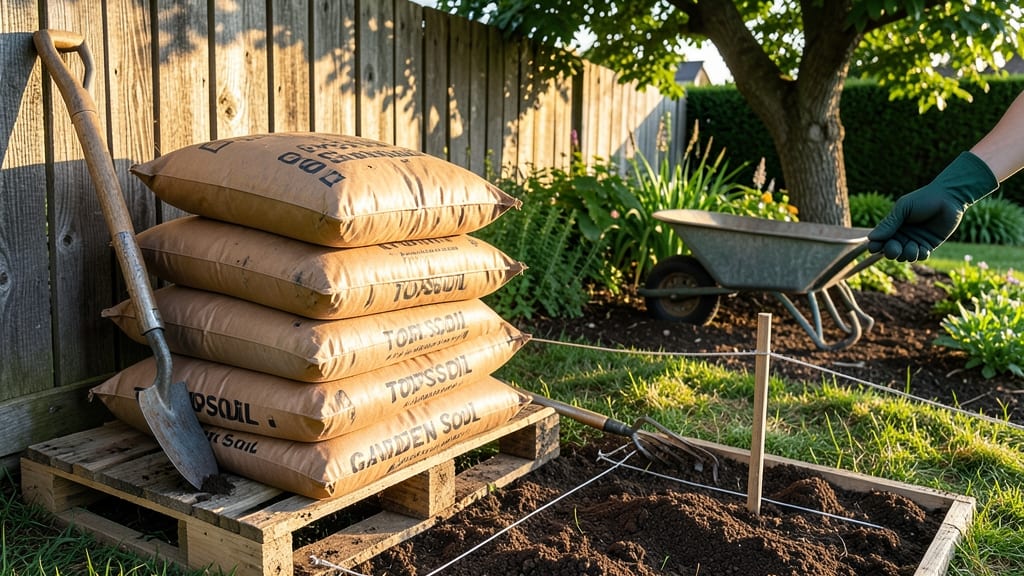
To cover 1 yard of garden area, you'll need about 27 standard 40-pound bags of topsoil for a 3-inch layer. For deeper applications (4-6 inches), plan for 36-54 bags—always check bag volume (cubic feet) and adjust for soil type or settling.
Understanding how many bags of topsoil fit in a yard starts with the math: 1 cubic yard equals 27 cubic feet.
Most 40-pound bags contain roughly 0.75 cubic feet, so 27 bags cover 3 inches of space. 🌱 For deeper beds or heavier soils, you'll need more—think of it like stacking bricks: each extra inch doubles the volume needed.
Pro tip: Measure your work area first, then multiply length × width × depth (in feet) ÷ 27 to get exact cubic yards before ordering.
Bag sizes vary wildly—some 50-pound bags only hold 0.6 cubic feet, while bulk bags might cover 1 cubic yard each. Always check the label for cubic feet, not just weight, since moisture content changes how much space each bag actually fills.
For raised beds or sandy soils, add 10-20% extra to account for settling and uneven surfaces.
💡 In This Article
- Calculating Topsoil Volume for Garden Projects
- Topsoil Bag Sizes and Coverage Guide
Calculating topsoil volume for garden projects
At its core, determining how many bags of topsoil you need comes down to simple geometry: multiply your garden's length by width by desired depth (all in feet), then divide by 27. This works because 1 cubic yard equals 27 cubic feet—the standard measurement for topsoil coverage.
For example, a 10×10-foot area with a 3-inch layer requires 3 cubic yards (10×10×0.25 ÷ 27 = 0.93 cubic yards, rounded up). The key is converting inches to feet (3 inches = 0.25 feet) before multiplying.
Bag sizes complicate things because weight doesn't equal volume. A 40-pound bag typically holds about 0.75 cubic feet, while a 50-pound bag might only contain 0.6 cubic feet due to moisture content. This is why labels list cubic feet—not just weight.
For instance, a 20-pound bag often covers 0.5 cubic feet, making it less efficient for large projects. Always check the manufacturer's specs, as variations can affect your total by 10-20%.
Soil compaction and moisture play surprising roles in coverage. Loose, dry topsoil settles 15-20% more than wet or compacted soil. Imagine pouring sand into a container—it fills differently when packed vs. loose. For raised beds, add an extra 10% to account for uneven surfaces.
Pro tip: Use a tape measure to verify depth after spreading—many gardeners overestimate their layer thickness by 1-2 inches, leading to wasted bags.
Here's a real-world scenario: A 5×8-foot vegetable garden with a 4-inch layer needs 1.48 cubic yards (5×8×0.33 ÷ 27). Using 40-pound bags (0.75 cubic feet), you'd need 54 bags (1.48×27 ÷ 0.75).
Round up to 56 bags to account for settling. For deeper layers, the math scales linearly—double the depth, double the bags needed.
Visualizing helps: Picture a 3-foot cube (1 cubic yard) as a stack of 27 standard shoeboxes. Each shoebox represents a cubic foot of topsoil. When you spread that cube over a garden, it covers 9 square feet at 3 inches deep.
This mental model makes it easier to adjust for different project sizes. 🌱
For precision, use this formula: Total bags = (Length × Width × Depth ÷ 27) ÷ Cubic feet per bag Always measure depth after spreading—most gardeners underestimate how much soil compacts under foot traffic.