
Light Requirements
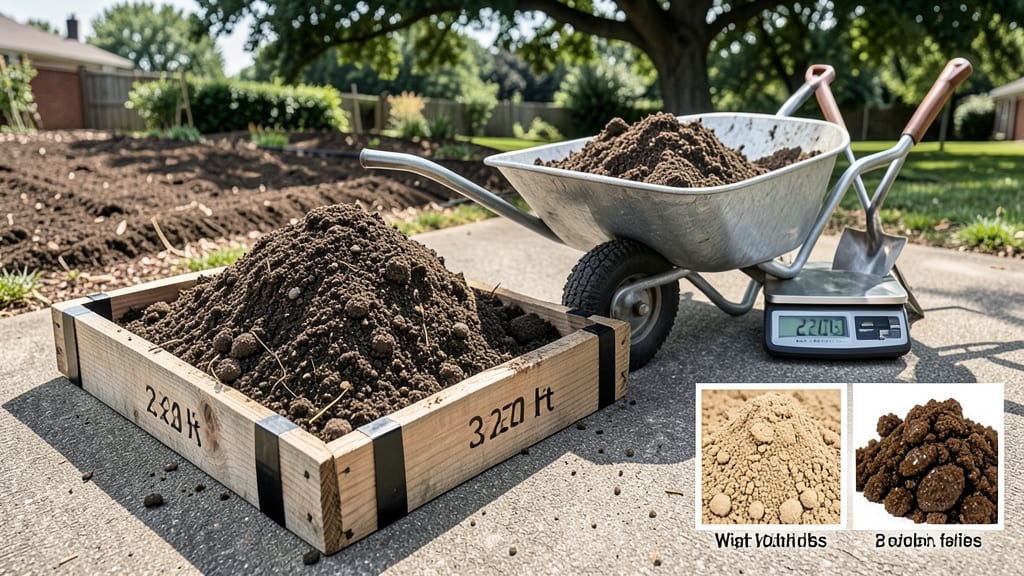
To determine how much 1 cubic yard of soil weighs, expect 2,000 to 2,800 pounds—though sandy soils run lighter (around 2,000 lbs) while clay-heavy soils can exceed 3,000 lbs when saturated. Ideal garden loam typically weighs 2,200–2,500 lbs per cubic yard when dry.
Understanding soil weight helps with everything from landscaping to construction projects. The variations come down to what's inside that cubic yard—moisture, organic matter, and particle size all play a role.
For instance, a dry, sandy soil might weigh closer to 2,000 lbs, while the same volume of wet clay could push over 3,000 lbs due to water absorption. 💧 Gardeners often work with loam because it balances weight and nutrients, usually landing in that 2,200–2,500 lb range when properly amended.
This weight difference isn't just academic—it affects everything from truckload deliveries to erosion control projects. A saturated clay soil could be nearly 50% heavier than its dry counterpart, which means planning for extra capacity when hauling or moving large volumes.
I always recommend checking moisture levels before estimating, especially in seasonal climates where freeze-thaw cycles can dramatically alter soil density.
💡 In This Article
- Soil Density Factors Affecting Weight in Cubic Yards
- Practical Weight Calculations for Gardening Projects
Soil density factors affecting weight in cubic yards
Soil weight varies dramatically because it's not just dirt—it's a complex mix of minerals, water, air, and organic matter. The particle size plays the biggest role: sand has large, loose particles with minimal surface area, so a cubic yard weighs around 2,000-2,400 lbs when dry.
Clay, with its tiny, tightly packed particles, can hold 3-5 times its weight in water, pushing saturated clay to 3,000+ lbs per cubic yard. Silt falls somewhere in between, with weights typically between 2,200-2,600 lbs depending on moisture.
Moisture is the wild card—water adds significant weight. A 10% moisture increase can add 200-400 lbs to that cubic yard, turning a manageable load into a heavy one. 💧 Clay soils absorb water like a sponge, while sandy soils drain quickly.
Organic matter (like decomposed leaves or compost) also affects weight—it's lighter than minerals but adds nutrients. For example, peat moss can reduce overall density by 10-15% compared to mineral-heavy soils.
Compaction matters too. Disturbed soil (like freshly tilled garden beds) weighs less because it's less dense, while compacted soil (like roadside fill) can weigh 20-30% more per cubic yard. Seasonal changes amplify this—freeze-thaw cycles in winter expand clay particles, reducing density temporarily, while summer drought compacts sandy soils.
This is why construction projects often test soil density before excavation, using tools like nuclear density gauges for precise measurements.
Here's a quick comparison of bulk densities (lbs per cubic foot, since 1 cubic yard = 27 cubic feet):
- Sandy soil: 90-100 lbs/ft³ (2,430-2,700 lbs/yd³ dry)
- Loam (ideal garden soil): 75-90 lbs/ft³ (2,025-2,430 lbs/yd³)
- Clay soil: 70-110 lbs/ft³ (1,890-2,970 lbs/yd³, higher when wet)
- Organic-rich soil: 40-60 lbs/ft³ (1,080-1,620 lbs/yd³)
For gardeners, this means your loam-based raised beds will weigh consistently around 2,200-2,500 lbs per cubic yard, but adding compost or peat moss can lighten the load. Construction sites, however, often deal with heavier, more compacted soils that require heavy machinery to move.
What most people overlook is how seasonal changes affect these numbers. A clay soil that weighs 2,800 lbs in summer might swell and crack in winter, temporarily reducing its weight by 10-15% until it re-saturates. This variability is why professionals always test soil conditions before making weight-based decisions.