
Landscaping
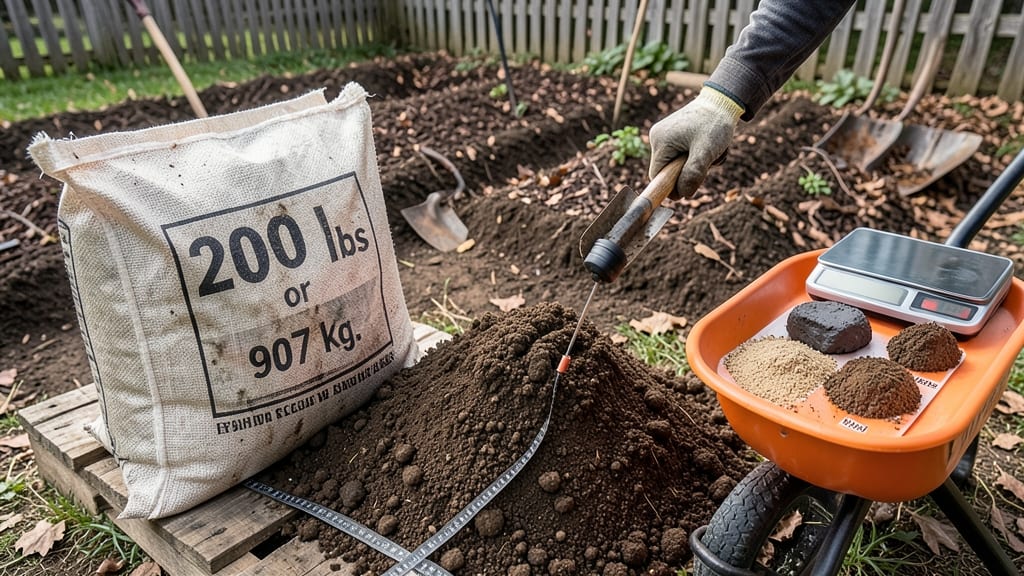
Determining the weight of one cubic yard of soil reveals a range between 2,000 and 3,000 pounds, influenced heavily by its moisture level and composition—clay-heavy soil can reach up to 3,200 pounds, while sandy soil often falls to 1,600 pounds. Water saturation alone can add up to 50% more weight to the total.
Understanding soil weight isn't just about numbers—it's about how those numbers change based on what's in your yard. 🌱 Clay particles pack tightly, making the soil denser and heavier, while sandy soil leaves more air pockets, reducing overall mass.
Even a small shift in moisture can drastically alter the weight, which is why landscapers always check soil conditions before estimating loads for projects.
For example, a raised garden bed filled with moist loam might weigh closer to 2,500 pounds, but if it dries out completely, that same volume could drop below 2,000 pounds.
This variation matters most when planning heavy lifting or transportation. A wheelbarrow designed for 500 pounds of soil might struggle with wet clay, while dry sand could be manageable. Always factor in seasonal changes—spring rains could turn your project into a weighty challenge overnight.
For precise calculations, consider using a moisture meter or consulting local soil reports, as regional compositions vary widely.
💡 In This Article
- How Soil Composition Affects Weight per Cubic Yard
- Practical Weight Calculations for Gardening Projects
How soil composition affects weight per cubic yard
Soil weight varies dramatically based on its particle size and composition. Clay particles, which are tiny and plate-like, pack tightly together, creating dense soil that can weigh up to 3,200 pounds per cubic yard when dry.
In contrast, sandy soil has larger, round particles that leave plenty of air gaps, reducing weight to as little as 1,600 pounds per cubic yard. The difference comes down to porosity—clay holds water and particles tightly, while sand lets water drain quickly and maintains more air space. 🌍
Moisture plays an even bigger role than particle size. Water fills the spaces between particles, adding significant weight. A cubic yard of dry clay might weigh 2,800 pounds, but when fully saturated, that same volume can swell to 3,600 pounds—a 30% increase.
Sandy soil shows less dramatic changes, but even it can gain 50% more weight when wet. This is why spring and fall projects often require heavier equipment—soil is at its heaviest after rain.
Organic matter like compost or humus also adds weight, as decomposed plant material contains more water and nutrients than mineral particles.
The bulk density of soil (weight per unit volume) helps explain these differences. Clay soils typically have bulk densities of 1.1-1.6 g/cm³, while sandy soils range from 1.4-1.8 g/cm³—but the air pockets in sand reduce overall weight.
Silt, which falls between clay and sand in size, usually sits around 1.2-1.5 g/cm³. Understanding these densities helps landscapers predict how much soil they'll need to move or how much support a garden bed requires.
For example, a 4'x8' raised bed filled with clay soil could weigh over 1,000 pounds, while the same bed with sandy soil might only hit 700 pounds. 🔍
Regional soil types further complicate calculations. In the Pacific Northwest, volcanic soils often contain heavy minerals like basalt, increasing weight beyond typical ranges. Meanwhile, coastal areas with high organic content might see lighter, more fibrous soils.
Always check local soil reports or conduct a simple test: dig a hole, weigh a known volume of soil, and adjust your estimates accordingly. This hands-on approach beats relying on averages, especially when precision matters for structural projects. 📊
One often-overlooked factor is compaction. Disturbed soil, like that from a construction site, can weigh 10-20% more than undisturbed soil due to reduced air pockets. Even walking on garden beds can compact the top layer, increasing its effective weight.
For accurate calculations, consider testing soil in its natural state before any disturbance. This ensures your weight estimates align with real-world conditions rather than theoretical models. 🏗️
For gardeners, these variations mean your 1 cubic yard of "soil" might not behave like your neighbor's. A mix of loam (equal parts sand, silt, and clay) typically falls in the 2,200-2,600 pound range, but adding compost or peat moss can push it closer to 2,800 pounds.
Always account for these nuances when planning projects—whether you're building a raised bed or calculating erosion control measures. The right soil mix isn't just about fertility; it's about managing weight and stability too. ✨