
Light Requirements
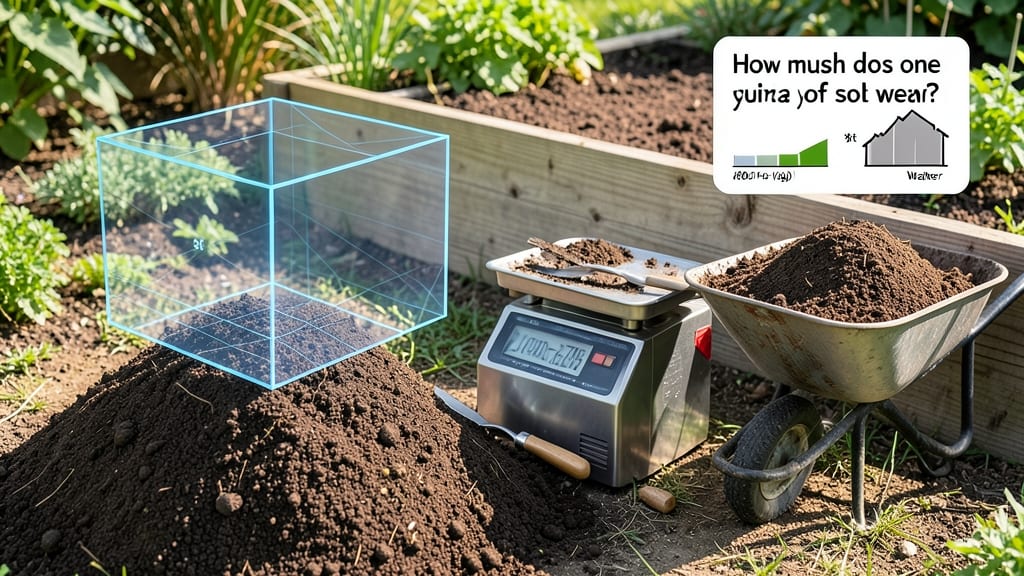
To determine how much one cubic yard of soil weighs, expect a range of 2,000 to 2,800 pounds, influenced by moisture levels, organic content, and soil composition—sandy soil typically registers closer to 2,200 pounds, while clay-heavy soil can surpass 3,000 pounds when fully saturated. Water content alone can double the weight of dry soil.
Understanding soil weight isn't just about numbers—it's about the science behind what you're working with. 🌱 Sandy soils weigh less because their large particles create more air pockets, while clay soils pack tightly and absorb more water, adding significant bulk.
For gardening projects, this matters when calculating how much soil you'll need for raised beds or how heavy your wheelbarrow will be after a rain. I always recommend testing moisture levels before estimating weight, as even a 10% increase in water content can add hundreds of pounds to your load.
For practical applications, like filling a 4'x8' raised bed (which holds about 1 cubic yard), you'll want to account for compaction. Loose soil weighs less initially but settles over time, while pre-compacted soil (like topsoil from a bag) will be heavier upfront.
Tools like a moisture meter or simple density tests (weighing a known volume) can help refine your estimates, especially when mixing different soil types.
💡 In This Article
- Soil Weight Variations by Type and Moisture
- Practical Soil Weight Calculations for Gardening Projects
Soil weight variations by type and moisture
The weight of one cubic yard of soil isn't fixed—it's a dynamic value shaped by three core factors: particle size, moisture content, and organic material.
Sandy soils, with their large, loose particles, typically weigh around 2,200 pounds per cubic yard when dry because air fills 40-50% of the space between grains. In contrast, clay soils have tiny particles that pack tightly, reducing air pockets and increasing density to 2,600-3,000 pounds when dry.
The real game-changer is moisture: water weighs 8.34 pounds per gallon, and clay can absorb up to 50% of its weight in water, while sand holds just 10-20%. 💧
Here's how the science breaks down: soil porosity (the air/water space between particles) directly impacts weight. Clay's high surface area creates microscopic pores that trap water like a sponge, while sand's larger gaps drain quickly.
Organic matter—like decomposed leaves or compost—adds another layer: it's lighter than mineral soil but holds more water, increasing total weight.
For example, a mix of 30% organic material in clay soil can push the weight to 3,200 pounds when saturated, compared to 2,400 pounds for the same volume of dry, mineral-heavy clay.
Seasonal changes amplify these variations. After heavy rain, clay soil can swell by 20-30%, increasing its weight by 600-900 pounds per cubic yard overnight. In contrast, sandy soils show minimal weight gain because water drains through quickly.
This is why professional landscapers always test soil moisture before estimating loads—what feels "light" in summer may become surprisingly heavy after spring rains. 🌧️
Compaction plays a sneaky role too. Foot traffic or machinery can reduce air pockets by 15-25%, effectively increasing density. A compacted cubic yard of loam (a balanced mix of sand, silt, and clay) might weigh 2,500 pounds when loose but 2,800 pounds after being walked on.
This is why bagged topsoil—often pre-compacted—feels heavier than field soil of the same volume.
For precise calculations, consider these real-world examples:
- Sandy loam: 2,300-2,500 lbs (dry), 2,600-2,800 lbs (moist)
- Clay loam: 2,600-2,900 lbs (dry), 3,000-3,300 lbs (saturated)
- Peat moss (organic): 1,200-1,500 lbs (dry), 2,000+ lbs (wet)
The key takeaway? Soil weight is less about the "type" and more about the current conditions. A cubic yard of "clay soil" could weigh anywhere from 2,600 to 3,300 pounds depending on its moisture state.
For gardeners, this means weighing your wheelbarrow before and after loading can reveal surprising truths—like how that "light" compost mix suddenly became a workout after rain. 💪