
Vegetables
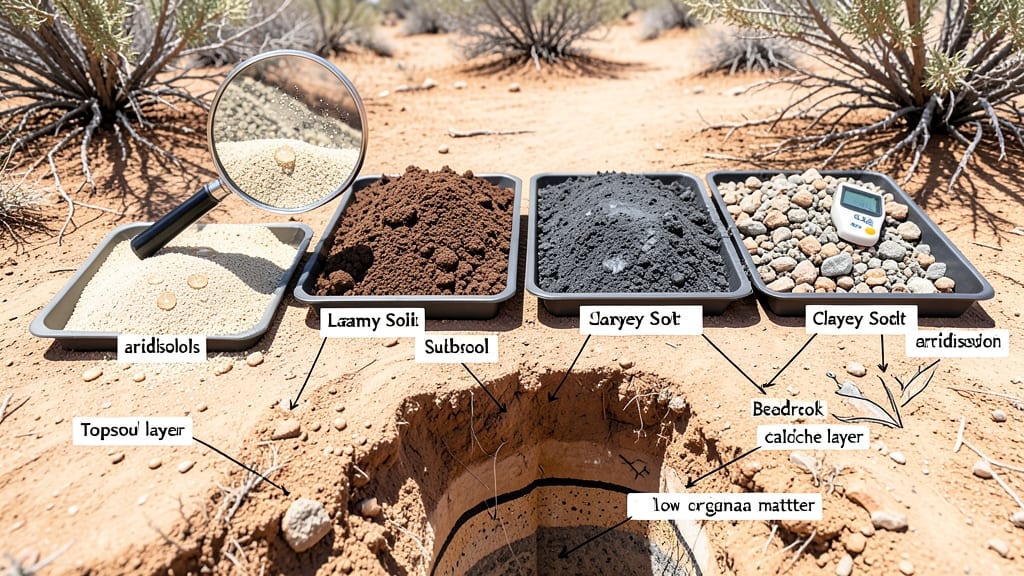
The types of soil in desert ecosystems primarily include aridisols, entisols, and specialized varieties like gypsum soils, all formed by extreme dryness, high evaporation rates, and mineral buildup that support resilient desert plants.
The harsh conditions of desert environments create unique soil profiles that differ dramatically from those in wetter climates.
Aridisols dominate these regions due to their low organic content and high mineral concentration, often forming a crusty surface that conserves precious moisture. 🌵 These soils develop slowly over centuries, with evaporation playing a key role in concentrating salts and carbonates near the surface—creating the signature white crusts seen in many deserts.
The parent rock beneath also shapes soil texture, ranging from fine sandy soils in some areas to rocky, gravelly substrates in others.
Understanding these soil types helps explain why certain plants thrive in deserts. For example, creosote bushes and palo verde trees have adapted to grow in aridisols by developing deep root systems to access groundwater.
Meanwhile, gypsum soils—rich in calcium sulfate—support specialized flora like desert marigolds. The interplay between soil chemistry and plant adaptations creates the distinctive ecosystems found in arid landscapes.
💡 In This Article
- How Desert Soils Form Through Climate and Geology
- Best Desert Plants for Each Soil Type and How to Cultivate Them
How desert soils form through climate and geology
Desert soils develop through a delicate balance of extreme climate conditions and geological processes. The dominant soil type, aridisols, forms in regions receiving less than 10 inches of rainfall annually.
Unlike humid soils that develop organic-rich layers, aridisols contain minimal organic matter—often less than 1%—because decomposition slows dramatically in dry conditions. The lack of moisture prevents microbial activity that would otherwise break down plant material into humus, leaving behind a mineral-heavy profile.
Evaporation plays a critical role in shaping desert soil chemistry. When sparse rainfall occurs, dissolved minerals like calcium carbonate and sodium chloride rise to the surface through a process called capillary action.
Over time, this creates the signature white crusts seen in many deserts, often composed of caliche (a hardened layer of calcium carbonate) or gypsum.
In some areas, like the Mojave Desert, these deposits can reach 3-6 inches thick, acting as a natural moisture barrier that forces plants to develop deep root systems to access groundwater.
The parent rock beneath desert surfaces also dramatically influences soil texture. In regions underlain by granite or sandstone, soils often develop a coarse, gravelly texture due to slow weathering processes. Conversely, areas with limestone bedrock produce finer, clay-rich soils with higher pH levels.
This geological diversity explains why some deserts have sandy soils (like parts of the Sonoran Desert) while others feature rocky substrates (common in the Atacama). The contrast with humid soils—formed through rapid organic decomposition and leaching—highlights how arid conditions create fundamentally different soil structures.
Temperature extremes further shape desert soils by accelerating chemical weathering. During the day, surface temperatures can exceed 120°F, causing minerals to expand and contract, while nighttime drops below freezing in many deserts.
This thermal cycling weakens rock formations and contributes to the formation of desert varnish—a dark, shiny coating on rocks created by manganese and iron oxides. These processes create the unique mineralogical signatures that make desert soils distinct from their temperate counterparts.
One fascinating adaptation in desert soils is their ability to store moisture in specialized layers. Some aridisols develop petrocalcic horizons—cemented layers of calcium carbonate that act like underground aquifers.
These layers can hold moisture for years, supporting deep-rooted plants like the saguaro cactus, which can access water from depths exceeding 6 feet. The contrast with non-desert soils, which typically have organic-rich top layers, demonstrates how desert soils have evolved specialized structures to survive in water-scarce environments.
The interplay between these factors creates the diverse soil types found across desert ecosystems. While aridisols dominate, entisols (young, minimally developed soils) appear in recently disturbed areas, and specialized soils like gypsum soils develop in regions with high calcium sulfate deposits.
This geological diversity explains why different desert plants thrive in specific soil conditions, from the salt-tolerant mesquite trees to the gypsum-loving desert marigold. 🌵