
Plants
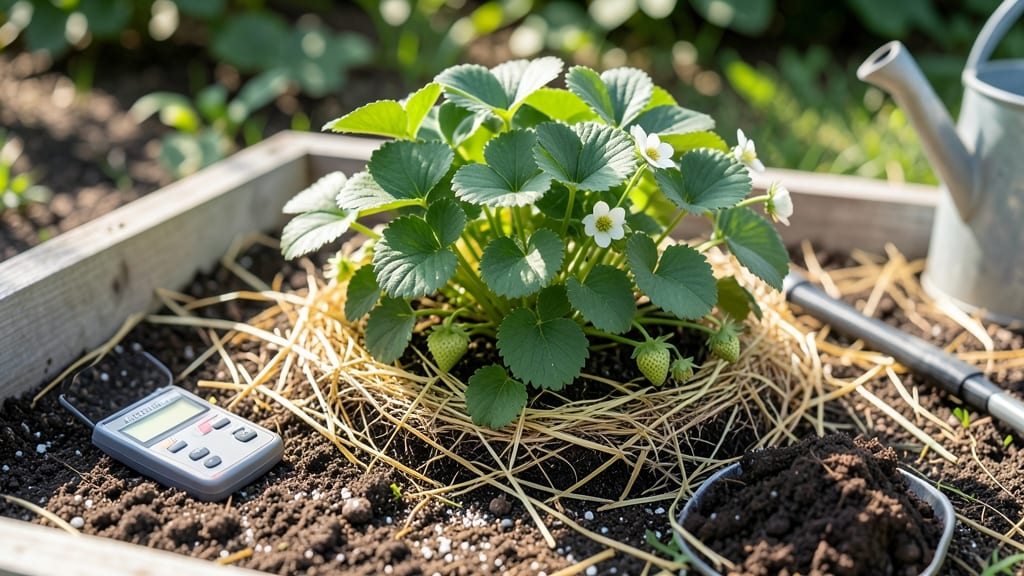
Strawberries prefer slightly acidic soil with a pH between 5.5 and 6.8, well-draining and rich in organic matter like compost or aged manure. Sandy loam or loamy soil blends work best to prevent root rot and maximize nutrient uptake.
Strawberries aren't picky about soil types, but they absolutely demand good drainage and the right acidity to access essential nutrients like iron and manganese. 🌱 I've found that even a slightly alkaline soil (above 7.0) can stunt growth because the plant struggles to absorb these critical minerals.
The ideal soil should crumble easily when moist but still hold enough moisture to keep roots hydrated without becoming waterlogged. For container gardening, I recommend mixing equal parts potting soil, compost, and perlite to create the perfect airy, nutrient-rich environment.
Most garden centers sell pre-mixed strawberry soil blends, but DIY mixes often perform better because you can tailor them to your local climate. For example, in heavy clay soils, adding coarse sand and peat moss creates the perfect balance.
If you're planting in spring, work in a 2-inch layer of compost before setting out your plants—this gives roots a nutrient boost right when they need it most.
💡 In This Article
- Strawberry Soil pH and Nutrient Requirements Explained
- Best Soil Mixes and Amendments for Strawberry Beds
Strawberry soil pH and nutrient requirements explained
The reason strawberries love slightly acidic soil (pH 5.5-6.8) comes down to their nutrient absorption system. At this pH range, the plant's roots can efficiently uptake iron and manganese—two critical micronutrients that become locked away in alkaline soils (above 7.0).
Iron deficiency, for example, shows up as yellowing leaves with green veins, while manganese deficiency leads to brown spots on older leaves. These nutrients are essential for chlorophyll production and energy transfer within the plant cells.
Strawberries also thrive when the soil contains balanced macronutrients: nitrogen for leafy growth, phosphorus for root development, and potassium for disease resistance. A soil test reveals that strawberries typically need 100-150 ppm nitrogen, 50-100 ppm phosphorus, and 150-200 ppm potassium during active growth.
The plant's shallow root system (usually no deeper than 12 inches) means it relies heavily on the topsoil layer for these nutrients. That's why organic matter like compost or worm castings is so valuable—they release nutrients gradually as microbes break them down.
You can test your soil's pH using a simple kit from garden centers or send a sample to a local agricultural extension office for professional analysis.
For quick fixes, sulfur lowers pH while lime raises it—though I recommend adjusting pH gradually (no more than 0.5 points per season) to avoid shocking plant roots. The ideal soil texture should feel like a damp sponge: firm enough to support roots but loose enough to allow oxygen flow.
Clay-heavy soils often need 20-30% sand or perlite added to improve drainage, while sandy soils benefit from 30-40% compost to retain moisture.
What most gardeners overlook is how soil temperature affects nutrient uptake. Strawberry roots prefer soil temps between 55-75°F—below 50°F, nutrient absorption slows dramatically. This is why spring planting often yields better results than fall planting in colder climates.
Mulching with straw (not wood chips, which can acidify soil) helps maintain stable soil temperatures while reducing moisture loss. The mulch layer also prevents soil-borne diseases from splashing onto leaves during rain.
For container growing, the nutrient dynamics change slightly because the root zone is limited. A 5-gallon pot needs repotting every 1-2 years as nutrients deplete, while larger containers can last 3-4 years.
I've found that adding a slow-release fertilizer (like 14-14-14 NPK) at planting time and top-dressing with compost every 6-8 weeks during fruiting keeps plants consistently productive. The key is monitoring leaf color—dark green indicates healthy growth, while pale yellow suggests nitrogen deficiency or poor drainage.
One advanced technique I've used with great success is foliar feeding during fruiting season. A light spray of chelated iron (0.25%) applied every 2 weeks ensures plants get their micronutrients even if soil conditions aren't perfect.
This works particularly well in raised beds where soil volume is limited. The foliar method also lets you bypass any soil pH issues temporarily while you work on long-term soil amendments. 🌱