
Landscaping
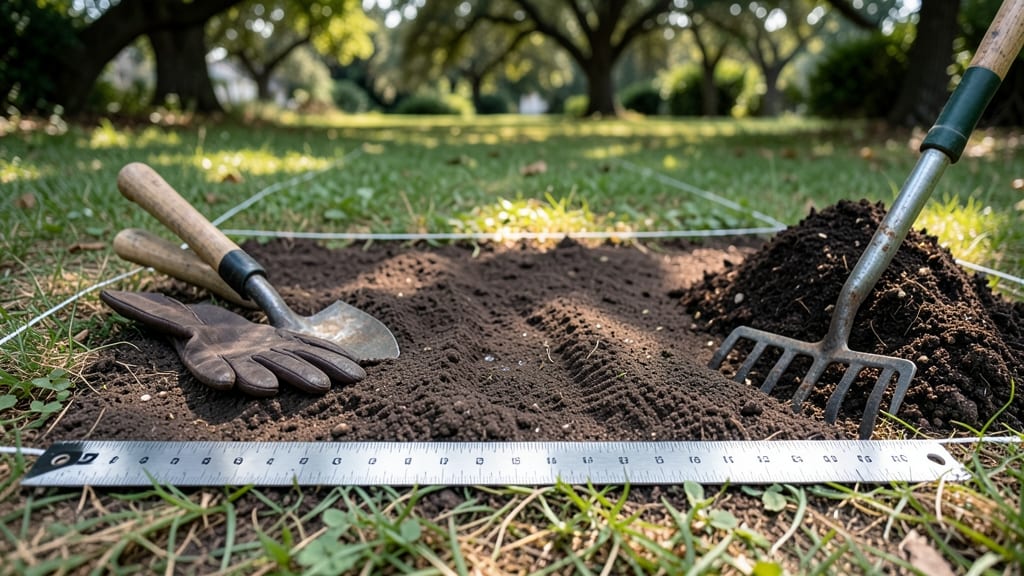
A yard of soil coverage equals 27 cubic feet, typically spreading 100 square feet at 3 inches deep or 25 square feet at 6 inches deep. Calculate coverage by multiplying area (sq ft) by desired depth (inches) and dividing by 324 (cubic feet per yard).
A yard of soil coverage equals 27 cubic feet because it's a 3-foot cube (3 × 3 × 3).
This means your coverage depends entirely on how deep you spread it. 🌱 For example, a 100-square-foot garden bed at just 3 inches deep will use one yard, but doubling the depth to 6 inches cuts that coverage in half.
Understanding this helps avoid buying too little or wasting money on extra soil when you don't need it.
Most gardeners aim for 6–12 inches of soil depth for vegetable beds to support root growth, while lawns typically need only 4–6 inches.
Mulch beds often use shallower layers (3–4 inches), but remember that amending soil with compost or sand can change its volume and settling behavior over time.
💡 In This Article
- How Soil Volume Calculations Work for Landscaping
- Best Soil Types and Depths for Garden Beds vs Lawns
How soil volume calculations work for landscaping
The foundation of soil volume calculations lies in understanding cubic feet. A cubic yard of soil equals 27 cubic feet because it's a perfect cube measuring 3 feet × 3 feet × 3 feet.
This standard measurement helps landscapers and gardeners determine how much soil they need for projects. The key factor is depth—soil coverage varies dramatically based on how thick you spread it.
Here's the math: To calculate how many yards of soil you need, multiply your project's area in square feet by the desired depth in inches, then divide by 324 (the conversion factor from cubic feet to cubic yards).
For example, a 100-square-foot garden bed at 3 inches deep requires exactly one yard of soil. Double that depth to 6 inches, and you'll need only half a yard for the same area. This inverse relationship between depth and coverage is why precise measurements matter.
Why does this formula work? It accounts for the fact that a cubic yard is a fixed volume, while coverage depends on how you distribute that volume across a surface.
Imagine pouring a cubic yard of soil into a shallow tray versus a deep container—the same volume covers vastly different areas. In landscaping, this principle helps you avoid common mistakes like buying too much soil (wasting money) or running short (leaving bare spots).
Consider real-world applications: A 500-square-foot lawn needing 4 inches of topsoil would require 5.56 yards of soil (500 × 4 ÷ 324). Round up to 6 yards to account for settling and uneven ground.
The formula also explains why professionals often sell soil in partial yards—most projects don't need whole-yard increments. This precision saves time and resources while ensuring your project meets its goals.
Depth isn't just about volume—it's about functionality too. Shallow layers (2–3 inches) work for mulch or seed beds, while deeper layers (6–12 inches) support root systems in vegetable gardens.
The soil's composition matters here: Sandy soil settles more than clay, and adding compost increases volume while improving fertility. Always account for these factors when calculating your needs.
For visual learners, think of soil coverage like a pizza: A 12-inch pizza (about 1 square foot) at 1 inch thick uses 1/324 of a cubic yard. Stack three of those pizzas (3 inches), and you've used up 1/108 of a cubic yard—enough for a 100-square-foot area.
This analogy helps translate abstract measurements into tangible results. 🌱