
Container Gardens
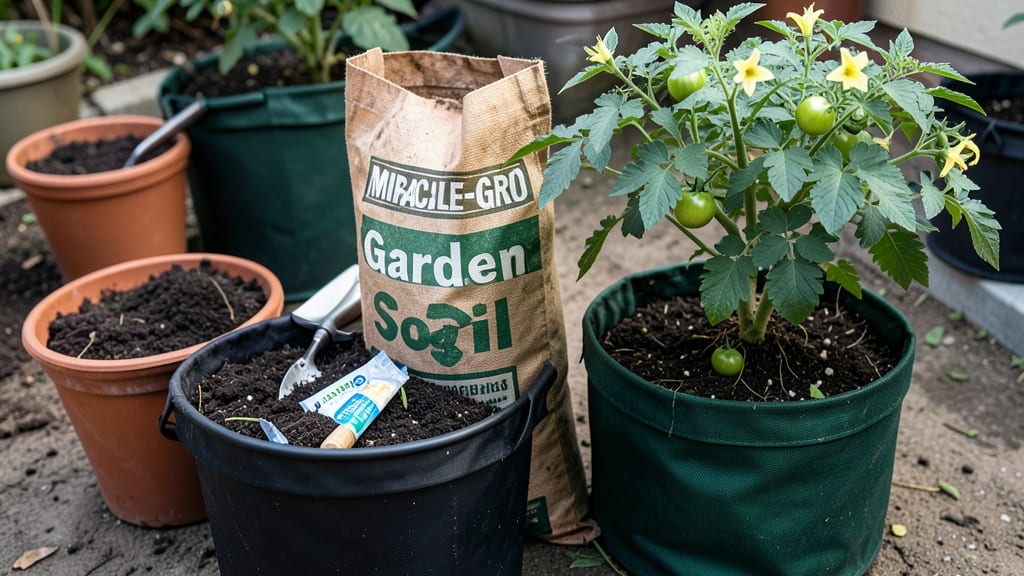
You can use Miracle-Gro Garden Soil in containers, but blending it with perlite or sand is crucial to improve drainage and prevent moisture buildup. Its dense formula often holds too much water for potted plants, so drainage holes in containers are a must to avoid root rot.
Miracle-Gro Garden Soil is formulated for in-ground planting, where natural soil structure helps manage moisture and airflow.
In containers, however, the lack of surrounding soil means roots have less space to expand, making proper drainage even more critical. 🌱 The dense texture of Miracle-Gro can suffocate roots if not amended, especially for plants like herbs or succulents that thrive in well-draining mixes.
I’ve found that adding 20-30% perlite or coarse sand creates the air pockets roots need to breathe while maintaining the soil’s nutrient benefits.
For container gardening, focus on creating a balance: start with a 60/40 ratio of Miracle-Gro to perlite for most plants, but adjust for moisture-loving varieties like ferns or moisture-sensitive ones like basil.
Always check your container’s drainage—if water pools after 10 minutes, you’ll need to adjust your mix or add more amendments. The key is mimicking natural soil’s structure while compensating for the confined space.
💡 In This Article
- Miracle-Gro Garden Soil Composition and Container Plant Needs
- Best Mixing Ratios for Miracle-Gro in Potted Gardens
Miracle-gro garden soil composition and container plant needs
Miracle-Gro Garden Soil is designed for in-ground use, where natural soil structure helps balance moisture and airflow. Its formula typically contains 40-50% peat moss—a dense, water-retentive material that works well in open beds but becomes problematic in containers.
In pots, this dense composition can trap excess moisture around roots, cutting off oxygen and creating the perfect conditions for root rot. Unlike potting mixes, which contain 20-30% perlite or vermiculite for aeration, Miracle-Gro’s blend lacks these air pockets, making it heavier and more compact.
The key issue is oxygen availability. Roots need 10-20% air space in their growing medium to function properly, but Miracle-Gro’s dense texture often provides only 5-10% air space when used alone.
This lack of oxygen forces roots to work harder, slowing growth and making plants more susceptible to disease. 🌿 For example, herbs like basil or cilantro—common container plants—require well-aerated soil to thrive, which Miracle-Gro alone simply can’t provide without amendments.
Another critical factor is water retention. While the soil’s moisture-holding capacity is ideal for in-ground gardens, containers dry out faster due to their limited volume. Without proper drainage, excess water lingers at the bottom, creating a waterlogged zone that suffocates roots.
This is why drainage holes are non-negotiable when using Miracle-Gro in pots. Even with holes, the soil’s density means water can still pool if not amended, leading to the same oxygen deprivation issues.
Consider the texture comparison: Miracle-Gro feels like wet sand when moist, while a good potting mix has a lighter, almost fluffy consistency. This difference isn’t just about feel—it directly impacts how quickly water drains and how easily roots can access nutrients.
For instance, a 5-gallon container filled with straight Miracle-Gro might hold 30% more water than the same container with a 60/40 mix of Miracle-Gro and perlite, dramatically altering plant health.
What most gardeners overlook is how plant types influence soil needs. Succulents, for example, require soil that dries out completely between waterings—a condition Miracle-Gro alone can’t provide.
On the other hand, moisture-loving plants like ferns or impatiens might actually benefit from the soil’s water retention, but even they need the improved aeration that amendments provide. The solution lies in understanding your plant’s native growing conditions and adjusting the mix accordingly.
Here’s what’s actually happening at the root level: When roots can’t access oxygen, they start producing ethanol as a byproduct of anaerobic respiration—a process that’s toxic to plants in high concentrations. This is why you might see yellowing leaves or stunted growth even when plants appear well-watered.
The dense Miracle-Gro soil exacerbates this issue in containers by limiting root expansion and oxygen flow. 💫