
How To
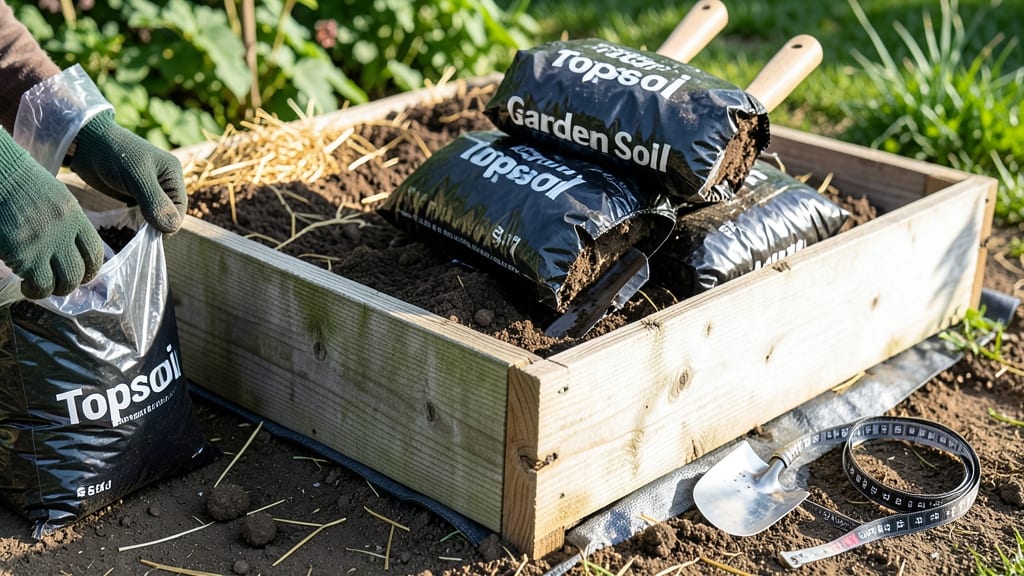
Calculating how many bags of soil for a raised bed starts with your bed’s dimensions: a standard 4’x8’ bed filled to 6 inches deep needs 32–36 2-cubic-foot bags, while deeper beds (10–12 inches) require 54–60 bags. Multiply your bed’s volume (length × width × depth) by 27 to convert cubic feet to cubic yards, then divide by your bag size for precise totals.
Figuring out soil quantity isn’t just about guessing—it’s about maximizing plant growth. 🌱 A deeper bed (10+ inches) lets roots spread comfortably, but too much soil can lead to waste.
I always recommend checking bag sizes (1 or 2 cubic feet) and adjusting for amendments like compost, which reduce the total volume needed.
For example, a 4’x8’ bed filled to 10 inches might need 48 bags of 2-cubic-foot soil, but adding 2 inches of compost first could cut that down by 8 bags.
Another key factor is soil type: lightweight potting mixes fill more volume than dense topsoil, so you’ll need fewer bags. Pro tip—measure your bed’s interior dimensions first, as frame thickness can eat up space.
And if you’re layering (e.g., cardboard for weed barrier + soil), account for each layer’s depth separately.
💡 In This Article
- Calculating Raised Bed Soil Volume: Key Factors
- Best Soil Mixes and Bag Sizes for Raised Gardens
Calculating raised bed soil volume: key factors
Understanding soil volume starts with the math behind cubic feet versus cubic yards. A standard 4’x8’ raised bed has a surface area of 32 square feet, but depth transforms that into actual space. For a 6-inch depth (0.5 feet), the volume is 32 × 0.5 = 16 cubic feet.
Since most soil bags are 2 cubic feet, you’d need 8 bags—but this is just the base. 🌱 The key is that soil settles over time, so most experts recommend adding 25-30% extra to account for compaction and moisture absorption.
Depth directly impacts root growth and soil stability. A 6-inch depth works for shallow-rooted plants like lettuce, but deeper beds (10-12 inches) are ideal for tomatoes or carrots, which need room to thrive.
For our 4’x8’ example, 10 inches equals 33.3 cubic feet—about 17 2-cubic-foot bags before accounting for settling. The rule of thumb is: every 1-inch increase in depth adds roughly 3.3 cubic feet to your total volume.
Bag size matters too—1-cubic-foot bags are lighter but require more trips, while 2-cubic-foot bags halve your total count. For instance, a 4’x8’x12-inch bed needs 54-60 2-cubic-foot bags, but 108-120 1-cubic-foot bags if you choose smaller sizes.
Pro tip: Check the bag’s labeled volume—some "2-cubic-foot" bags may actually contain 1.5 cubic feet after settling.
Soil type affects volume too. Potting mix is fluffier and may require 10-15% more bags than topsoil, which compacts tightly. For example, a 4’x8’x10-inch bed might need 48 bags of topsoil but 52 bags of potting mix.
Always factor in amendments: adding 2 inches of compost first could reduce your soil needs by 4-6 bags in a standard bed.
Here’s a quick conversion cheat sheet for common bed sizes:
- 4’x8’ bed: 6-inch depth = 16 cu. ft. (8 bags), 10-inch = 33 cu. ft. (17 bags)
- 4’x4’ bed: 6-inch = 8 cu. ft. (4 bags), 12-inch = 24 cu. ft. (12 bags)
- 8’x4’ bed: 8-inch = 26.7 cu. ft. (14 bags), 12-inch = 40 cu. ft. (20 bags)
Always measure your bed’s interior dimensions—frame thickness can reduce usable space by 1-2 inches on each side. For example, a 4’x8’ exterior bed might only have a 3’8”x7’8” interior, cutting your volume by 5-10%. 💫