
Light Requirements
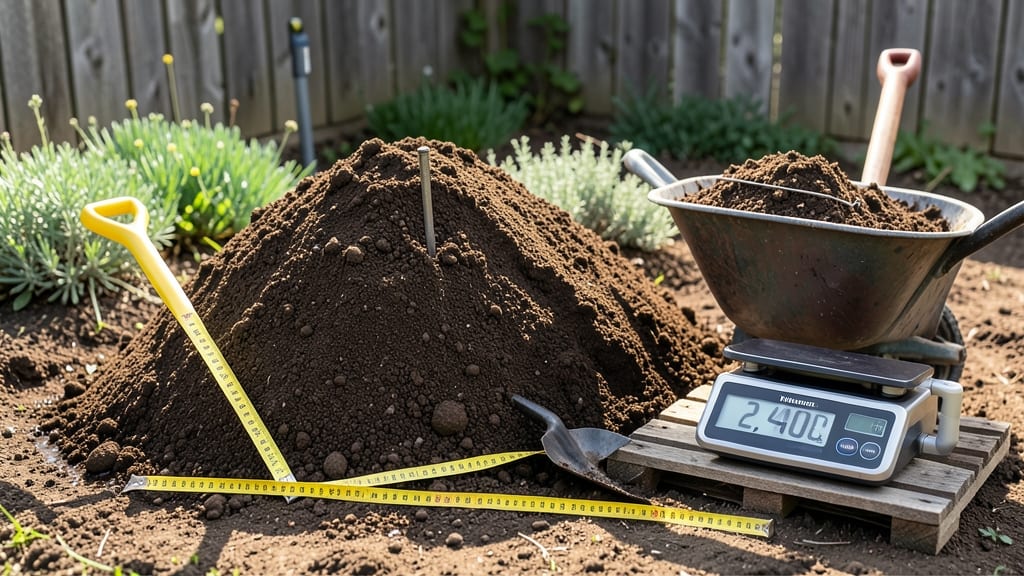
Four yards of topsoil weighs 1,600 to 2,400 pounds depending on its composition—sandy topsoil sits at the lighter end (~1,600 lbs), while clay-heavy or loamy types can push past 2,200 lbs. Always verify with your supplier since moisture levels and compaction drastically alter the final weight.
Understanding topsoil weight isn't just about the yardage—it's about the hidden variables that turn a simple calculation into a logistics puzzle. 🔥 The biggest factor is moisture: freshly delivered topsoil can weigh 30% more when saturated compared to dry conditions.
For example, a loamy mix (the most common type) might tip the scales at 2,000 lbs when damp but drop to 1,700 lbs after drying. I always recommend requesting a moisture-adjusted estimate from suppliers, especially for large projects where delivery trucks have strict weight limits.
This weight range also affects your project planning. A lightweight sandy topsoil might be easier to spread by hand, while heavier clay mixes require heavy machinery.
Many landscapers I know order 10% more than calculated to account for unexpected density variations—trust me, you don't want to run short mid-project when your supplier can't deliver immediately.
💡 In This Article
- Topsoil Weight Variations by Density Type
- Calculating Topsoil Weight for Landscaping Projects
Topsoil weight variations by density type
The weight of four yards of topsoil isn't fixed—it's a dynamic range shaped by particle size and mineral composition. Sandy topsoil, with its large, loosely packed grains, weighs about 1,600 pounds because air fills the gaps between particles, reducing overall density.
Clay-heavy soil, on the other hand, packs tightly with minuscule particles that trap moisture, pushing weights to 2,200+ pounds—that's nearly 40% heavier than sandy soil for the same volume. The middle ground is loamy soil, a balanced mix that typically falls between 1,800-2,100 pounds.
Moisture plays a dramatic role here. Freshly delivered topsoil can hold up to 30% more water by weight, which adds significant pounds—imagine your 2,000-pound loamy order suddenly becoming 2,600 pounds after a rainstorm.
This is why suppliers often provide "dry weight" estimates: the actual delivered weight can vary by 20-30% depending on recent weather. Even the same soil type can shift by 100-200 pounds between dry and saturated states.
Regional variations also matter. Topsoil from volcanic regions (like Hawaii) often contains heavier minerals, while coastal areas produce lighter, sandier mixes. For example, topsoil from Florida's limestone-rich soils might weigh 1,900 pounds, while Pacific Northwest clay soils could hit 2,300 pounds for the same volume.
These differences explain why local suppliers' density charts always include regional adjustments—what works in Texas won't necessarily apply in New England.
Compaction changes everything. Loose, freshly tilled topsoil weighs less than when it's been compacted by machinery or foot traffic. A 10% compaction increase (common after heavy equipment passes) can add 150-250 pounds to your four-yard order.
This is why professional landscapers always specify "loose volume" when ordering—it accounts for the natural settling that happens during spreading. 💫
Here's a quick comparison of common soil types:
- Sandy topsoil: 1,600-1,800 lbs (least dense, highest air content)
- Loamy topsoil: 1,800-2,100 lbs (balanced particles, moderate moisture retention)
- Clay-heavy topsoil: 2,200-2,400+ lbs (highest density, poor drainage)
- Organic-rich topsoil: 1,700-2,000 lbs (lighter but nutrient-dense)
The key takeaway? Always ask suppliers for their "in-place density" measurement—the weight per cubic yard after accounting for natural settling and moisture variations. This single number will save you from weight surprises that could overburden delivery trucks or leave your project short-handed. 🔥