
Light Requirements
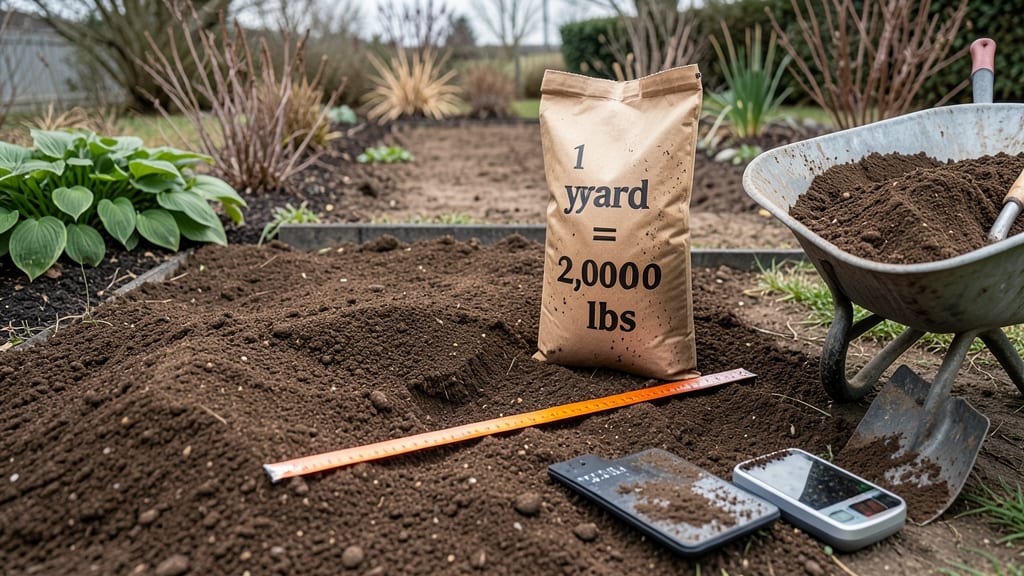
A yard of screened topsoil typically weighs between 2,000 and 2,700 pounds, depending on moisture content and compaction—moist soil is heavier, while dry or loose soil may skew lighter. Always confirm with suppliers, as regional soil composition varies significantly.
A yard of screened topsoil's weight isn't just about volume—it's a science of density.
Moisture alone can swing the scale by 300-500 pounds between dry and saturated conditions, while clay-heavy soils often exceed 2,700 pounds per cubic yard. 🔥 I've seen suppliers in Florida quote 2,200 pounds for the same topsoil in Texas due to different organic matter percentages.
For accurate planning, always ask for a moisture-adjusted weight estimate.
This variation matters most when calculating delivery costs or truck capacity. A typical dump truck handles 10-15 cubic yards at 2,500 pounds per yard, but compacted clay loads can push trucks to their 20,000-pound limits faster.
I recommend ordering 10% extra for projects requiring deep tilling, as compaction reduces usable volume by up to 15% after spreading.
💡 In This Article
- Factors Affecting Screened Topsoil Weight
- Practical Tips for Estimating Topsoil Delivery Costs
Factors affecting screened topsoil weight
Screened topsoil weight varies primarily due to its moisture content, which can shift the scale dramatically. A cubic yard of dry screened topsoil might weigh around 2,000 pounds, but when saturated—like after a rainstorm—it can balloon to 2,700 pounds or more.
This happens because water fills the pores between soil particles, increasing overall density. For example, sandy soils absorb water quickly but drain fast, while clay-heavy soils retain moisture longer, keeping weights elevated. 🔥
The organic matter percentage plays a critical role too. Topsoil with 5-10% organic content (like decomposed leaves or compost) tends to weigh less than mineral-heavy soils because organic material has lower bulk density. Meanwhile, clay particles pack tightly, creating a heavier composition—sometimes exceeding 2,700 pounds per cubic yard.
Regional differences matter: Florida’s sandy topsoil often weighs 2,200 pounds, while Midwest clay soils can hit 3,000 pounds when wet.
Compaction further complicates weight estimates. When soil is spread and tamped down—like in a garden bed—it loses 10-20% of its volume, but the weight per cubic yard remains nearly identical.
This is why suppliers use weight ranges: a "yard" of topsoil might measure 27 cubic feet when loose but only 24 cubic feet after spreading. For projects like raised beds, always account for this shrinkage to avoid shortages. ✨
Particle size distribution also affects weight. Screened topsoil removes large rocks and debris, leaving finer particles that pack more densely. Coarse, gravelly soil might weigh less (1,800 pounds), while fine, silty topsoil can approach 2,800 pounds.
Testing moisture levels with a simple soil moisture meter (or the "squeeze test") helps gauge real-time weight variations before ordering.
Temperature and seasonality introduce another layer. Cold, damp soils in spring weigh more than dry summer blends. I’ve seen suppliers adjust winter deliveries by 10-15% to account for frozen moisture. Always ask for a moisture-adjusted weight certificate—some reputable suppliers provide this to avoid delivery surprises. 💫
For precise calculations, multiply your cubic yards by the supplier’s quoted weight per yard. For instance, a 5-cubic-yard order of topsoil at 2,500 pounds/yard equals 12,500 pounds—but if moisture spikes to 2,700 pounds/yard, the total jumps to 13,500 pounds.
This difference can determine whether a truck’s 20,000-pound capacity is exceeded.